Personal injury lawyer SEO statistics
153 Personal Injury Lawyer SEO Statistics 2026
Primary sources only. Injured people are not searchers. A Google floor is not a mill census. A retainer is not a ranking guarantee.
Updated SEPTEMBER 2026
Written by Jonathan Mahler, reviewed by Jonathan Mahler. Operator notes, not legal advice.
Injured people are not searchers. Vehicle miles are not query volume. A paid legal click is not an organic ranking, and an organic ranking is not a signed case. This page is the citation ledger for personal injury lawyer *organic* SEO: crash and driving demand, why PI sites fail Google's floors, what SEO sellers charge, how mobile accident-intent discovery actually is, and what leaks between the click and the retainer.
The commercial how-to lives on personal injury lawyer SEO. The organic PI system umbrella is personal injury marketing. Paid CPC and LSA-as-ads depth live on personal injury lawyer advertising statistics. National SERP economics and AI Overviews live on law firm SEO statistics. Map pack, GBP, and NAP live on law firm local SEO statistics. Website UX and script-stack census live on law firm website statistics. This URL does not merge with any of them. Updated September 2026.
Key Takeaways
- An estimated 2.42 million people were injured in U.S. motor vehicle traffic crashes in 2024. That is demand substrate for injury hire queries, not a count of people who searched for a lawyer (NHTSA, Apr 2026).
- Traffic fatalities fell to 39,254 in 2024, down 4.3% from 41,025 in 2023 (NHTSA, Apr 2026).
- Unadjusted U.S. travel jumped from 244,989 million vehicle miles in February 2026 to 283,207 million in March 2026, a 15.6% month-to-month rebound into spring (FHWA, Mar 2026).
- Google's doorway-abuse examples include multiple domains or pages targeted at specific regions or cities that funnel users to one page. That is a spam rule, not a census of PI mills (Google Search Central, Aug 2026).
- Scaled content abuse includes using generative AI to generate many pages without adding value for users. Sites that violate spam policies may rank lower or not appear (Google Search Central, Aug 2026).
- Search quality raters apply very high Page Quality standards to Your Money or Your Life topics because low-quality pages could negatively impact health, financial stability, safety, or societal welfare. Ratings do not directly set rankings (Search Quality Rater Guidelines, Sep 2025).
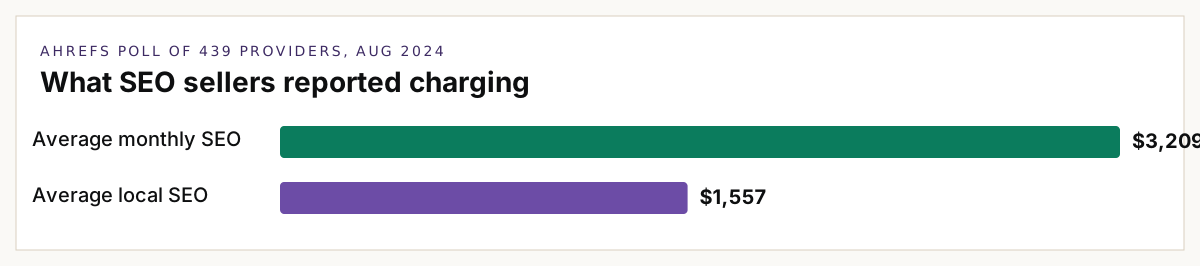
- SEO agencies in Ahrefs' poll of 439 providers averaged $3,209 per month. That is what sellers reported charging, not a PI-metro invoice (Ahrefs, Aug 2024).
- Local SEO averaged $1,557 per month in the same poll (Ahrefs, Aug 2024).
- 91% of U.S. adults own a smartphone in Pew's 2025 NPORS wave. PI hire pages that fail on a phone fail the default device (Pew Research Center, Nov 2025).
- In July 2026, 1,440 of Conduit Law's 2,060 organic clicks arrived on mobile, about 70%. One-firm historical proof, not a universal PI mobile rate (LawVert, Jul 2026).
- The public Conduit stack includes 508 location pages with courts, corridors, and trauma centers rather than city-name swaps (LawVert, Sep 2026).
- Over the trailing year ending 25 August 2026, Conduit Law recorded 66 SEO-attributed signed cases. Historical one-firm results, not a ranking or signed-case guarantee (LawVert, Aug 2026).
- Attorneys and Legal Services posted the highest industry median Google Ads CPC at $9.87 in WordStream's 2026 benchmarks. Blended legal auction intensity, not a PI head-term organic cost. Paid depth lives on the PI advertising statistics hub (WordStream, May 2026).
- 78.2% of those SEO providers charge a monthly retainer, which is how firms actually buy ongoing organic capacity (Ahrefs, Aug 2024).
What drives personal injury organic demand?
Crash counts and miles driven are the substrate under car-crash, truck, and injury hire queries. They are not a search-volume census. If you judge a PI organic program on a January Search Console screenshot, you are grading winter trough traffic as if it were the market.
How many people are injured (and killed) in U.S. traffic crashes in the latest NHTSA year?
The 2024 overview is a research note, not a lawyer-search survey. Use it to size the injury world your pages sit in.
- Police-reported motor vehicle traffic crashes rose to 6,180,241 in 2024 from 6,138,474 in 2023, a 0.7% increase that was not statistically significant (NHTSA, Apr 2026).
- Fatal crashes fell 3.9%, from 37,769 in 2023 to 36,297 in 2024 (NHTSA, Apr 2026).
- Injury crashes fell 1.2%, from 1,697,252 to 1,676,700 (NHTSA, Apr 2026).
- Property-damage-only crashes rose 1.4%, from 4,403,453 to 4,467,244 (NHTSA, Apr 2026).
- The injury rate was 74 people injured per 100 million VMT in 2024, down from 75 in 2023 (NHTSA, Apr 2026).
- The fatality rate was 1.19 per 100 million VMT in 2024, down 5.6% from 1.26 in 2023 (NHTSA, Apr 2026).
- FHWA annual VMT, as cited in the NHTSA note, rose 1.5% from 3,247 billion miles in 2023 to 3,294 billion in 2024 (NHTSA, Apr 2026).
- Passenger-car occupants injured fell a statistically significant 4.6%, from 919,091 in 2023 to 877,252 in 2024 (NHTSA, Apr 2026).
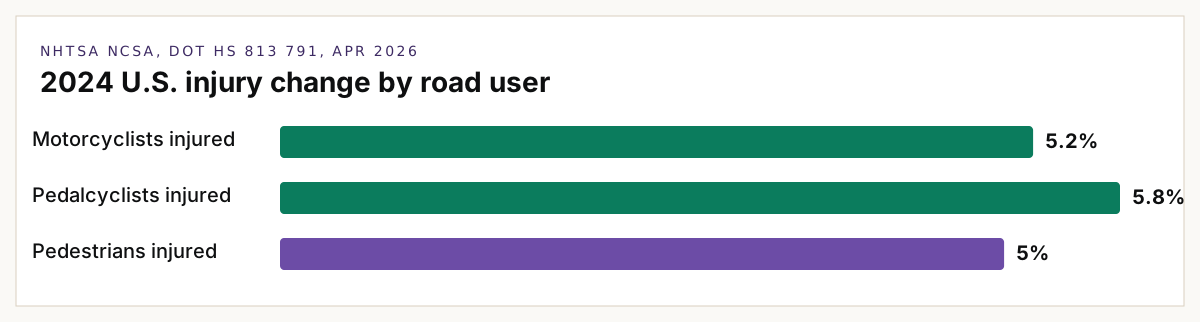
- Motorcyclists injured rose a statistically significant 5.2%, from 82,567 to 86,887 (NHTSA, Apr 2026).
- Pedestrians injured rose 5.0%, from 68,241 to 71,635 (NHTSA, Apr 2026).
- Pedalcyclists injured rose 5.8%, from 49,989 to 52,887 (NHTSA, Apr 2026).
- SUV occupants injured rose 4.2%, an increase of 28,952 people (NHTSA, Apr 2026).
- Pickup occupants injured fell a statistically significant 9.2% (NHTSA, Apr 2026).
- Pedestrian fatalities were 7,080 in 2024, down 3.9% (NHTSA, Apr 2026).
- Motorcyclist fatalities were 6,228, down 2.2% (NHTSA, Apr 2026).
- Alcohol-impaired-driving fatalities were 11,904 in 2024, 30% of all traffic deaths (NHTSA, Apr 2026).
- Speeding-related fatalities were 11,288, down 5.2% from 11,913 (NHTSA, Apr 2026).
- Among passenger-vehicle occupants killed in 2024 with known restraint use, 48% were unrestrained (9,758 people) (NHTSA, Apr 2026).
- People injured in crashes involving large trucks rose 5.0% from 2023 to 2024; other-vehicle occupants injured in those crashes rose 8.2% to 116,475 (NHTSA, Apr 2026).
- Nighttime fatalities (6 p.m. to 5:59 a.m.) were 20,971 in 2024, down 5.6% (NHTSA, Apr 2026).
- Hit-and-run crashes killed 2,758 people in 2024, including 1,749 pedestrians (25% of pedestrian deaths) (NHTSA, Apr 2026).
- Distraction-affected crashes accounted for 3,208 deaths, 8.2% of traffic fatalities in 2024 (NHTSA, Apr 2026).
- The note is DOT HS 813 791, published April 2026 by NHTSA's National Center for Statistics and Analysis (NHTSA, Apr 2026).
How sharply does U.S. vehicle miles traveled rebound from winter troughs into spring and summer?
FHWA's Traffic Volume Trends series is hourly counts from thousands of continuous counters, then scaled to national miles. Seasonal driving pressure is real. It is still not Google query volume.
- The same February-to-March rebound shows up across years: 236,170 million miles in February 2023 to 272,758 million in March 2023, about +15.5% (FHWA, Feb 2026).
- March 2023 unadjusted travel was 272,758 million miles in the later revised table (FHWA, Mar 2026).
- February 2024 was 242,287 million miles (FHWA, Feb 2026).
- March 2024 was 275,803 million miles, about +13.8% from that February (FHWA, Mar 2026).
- February 2025 was 238,728 million miles (FHWA, Feb 2026).
- March 2025 was 278,787 million miles, about +16.8% from that February (FHWA, Mar 2026).
- July is the summer peak in the latest table: 297,771 million miles in July 2026 (FHWA, Jul 2026).
- July 2025 was 297,161 million miles (FHWA, Jul 2026).
- July 2024 was 292,266 million miles (FHWA, Jul 2026).
- July 2023 was 287,583 million miles (FHWA, Jul 2026).
- February 2025 versus July 2025 is 238,728 million to 297,161 million miles, about +24.5% from winter trough to summer peak (FHWA, Jul 2026).
- July 2026 travel split 95.8 billion rural miles and 201.9 billion urban miles (FHWA, Jul 2026).
- March 2026 travel split 86.5 billion rural miles and 196.7 billion urban miles (FHWA, Mar 2026).
- February 2026 travel split 73.6 billion rural miles and 171.4 billion urban miles (FHWA, Feb 2026).
- July 2026 travel was 0.2% above July 2025 (FHWA, Jul 2026).
- Cumulative January-July 2026 travel was 1,941.4 billion miles, up 0.7% year over year (FHWA, Jul 2026).
- The moving 12-month total ending July 2026 was 3,337,505 million miles (FHWA, Jul 2026).
- Traffic Volume Trends is built from hourly counts at approximately 5,000 continuous traffic-counting locations nationwide (FHWA, Jun 2026).
- FRED republishes the not-seasonally-adjusted national VMT series as `TRFVOLUSM227NFWA` for charting; the origin remains FHWA (FRED, Sep 2026).
How expensive is the blended Attorneys and Legal Services search auction as a proxy for contested hire-query markets?
Read this as competition intensity for hire queries, not as the cost of SEO. Metro PI CPC tables, LSA product chapters, and paid creative mix belong on the PI advertising statistics hub.
- The same blended legal category posted the highest industry median cost per lead at $131.63. That is an in-platform lead, not a signed case (WordStream, May 2026).
- Cross-industry median CPC in that 2026 study was $5.42, so the legal median sits well above the all-industry line (WordStream, May 2026).
- The 2026 sample is 13,474 U.S. LocaliQ customer search campaigns running 1 April 2025 through 31 March 2026; figures are medians (WordStream, May 2026).
Why do PI sites fail organic: mills, doorways, and YMYL?
There is no origin census of "what percent of PI sites are doorway mills." Google publishes rules. Thin injury-times-city swaps fail those rules whether or not someone measured the mill rate. Unique city pages and practice hubs that can take the case are the commercial standard on personal injury lawyer SEO. Map-pack factors stay on law firm local SEO.
What does Google define as doorway abuse and city or region keyword stuffing?
Doorway language maps onto PI city mills almost one-to-one. It is still a policy definition, not an incidence percentage.
- Doorway examples also include generating pages to funnel visitors into the actually usable part of a site, and creating substantially similar pages that sit closer to search results than a clearly defined, browseable hierarchy (Google Search Central, Aug 2026).
- Keyword stuffing examples include blocks of text that list cities and regions a page is trying to rank for (Google Search Central, Aug 2026).
- Google detects policy-violating practices through automated systems and, as needed, human review that can result in a manual action (Google Search Central, Aug 2026).
- The SEO starter guide says each piece of content should be accessible through one URL, and that unique, people-first content is the baseline (Google Search Central, Dec 2025).
- Duplicate URLs are not automatically a spam violation, but they waste crawl and confuse users (Google Search Central, Dec 2025).
- Google does not accept payment to crawl a site more often or rank it higher, and does not guarantee crawl, index, or serving (Google Search Central, Dec 2025).
What is scaled content abuse, and how does search-engine-first content fail the helpful-content self-test?
A content mill that ships hundreds of injury-city pages is the scaled-content pattern whether a human, a contractor network, or a model typed the words.
- Other scaled-content examples include scraping feeds or search results and synonymizing them, stitching pages together without adding value, creating multiple sites to hide the scaled nature of the content, and generating many pages whose content makes little sense but contains search keywords (Google Search Central, Aug 2026).
- Google announced scaled content abuse, expired domain abuse, and site reputation abuse as new spam policies on 5 March 2024 (Google Search Blog, Mar 2024).
- The March 2024 scaled-content policy applies whether the pages were produced through automation, human effort, or a combination (Google Search Blog, Mar 2024).
- The helpful-content self-test treats content made primarily to attract visits from search engines as a warning sign (Google Search Central, Dec 2025).
- Producing lots of content on many different topics in hopes that some of it might perform, and using extensive automation to produce content on many topics, are the same warning list (Google Search Central, Dec 2025).
- Entering a niche topic area without real expertise, mainly because you thought you would get search traffic, is another fail on that self-test (Google Search Central, Dec 2025).
- Google says it does not have a preferred word count; writing to a particular word count because you heard Google prefers one is a search-engine-first tell (Google Search Central, Dec 2025).
- Using automation, including AI generation, to produce content for the primary purpose of manipulating search rankings is a spam-policy violation (Google Search Central, Dec 2025).
Why do legal and injury topics sit under a higher E-E-A-T and YMYL bar?
Injury advice can affect health, safety, and financial stability. That is a quality floor for Page Quality scrutiny. It is not legal advice, and it is not a score Google publishes for competitor PI sites.
- Google's systems give even more weight to strong experience, expertise, authoritativeness, and trustworthiness for topics that could significantly impact health, financial stability, safety, or societal welfare, which Google calls YMYL (Google Search Central, Dec 2025).
- Of the E-E-A-T aspects, trust is the most important (Google Search Central, Dec 2025).
- Search quality raters are trained on these concepts; rater data is not used directly in ranking algorithms (Google Search Central, Dec 2025).
- The full rater-program PDF in force for this page is the 11 September 2025 General Guidelines edition (Search Quality Rater Guidelines, Sep 2025).
- Section 2.3 states that some topics have a high risk of harm because content could significantly impact health, financial stability, or safety of people, or the welfare or well-being of society, and "We call these topics Your Money or Your Life or YMYL" (Search Quality Rater Guidelines, Sep 2025).
- YMYL Health or Safety covers topics that could harm mental, physical, and emotional health, or any form of safety (Search Quality Rater Guidelines, Sep 2025).
- YMYL Financial Security covers topics that could damage a person's ability to support themselves and their families (Search Quality Rater Guidelines, Sep 2025).
- YMYL is a spectrum: clear YMYL, definitely not YMYL, or in between. Pages on clear YMYL topics require the most Page Quality scrutiny (Search Quality Rater Guidelines, Sep 2025).
- Google's November 2023 rater-guidelines update restates that rater ratings do not directly influence ranking (Google Search Blog, Nov 2023).
- The starter guide is explicit that E-E-A-T itself is not a ranking factor (Google Search Central, Dec 2025).
If city pages are doorway-shaped and the practice hubs cannot finish intake, buying more URLs scales the miss. Book a 15-minute strategy call to look at architecture, not a mill quote.
What does SEO cost when firms buy organic capacity?
Ahrefs polled SEO *providers*. Contested PI metros often price higher, and there is no origin PI-retainer table in this pass. Clio's marketing-wallet figures are all-practice expenses, not an SEO line item. Do not treat WordStream CPC as the cost-of-SEO chapter.
What do SEO providers charge on average: agency versus freelancer retainers, local SEO, and retainer share?
Quote the poll. Do not invent a Denver or Miami PI retainer.
- Overall SEO averaged about $2,917 per month across the 439-provider poll (Ahrefs, Aug 2024).
- Freelancers averaged $1,348 per month on the tier-derived averages, versus $3,250 for consultancies (Ahrefs, Aug 2024).
- 63% of pricing falls between $500 and $5,000 per month (Ahrefs, Aug 2024).
- The most popular monthly band is $501 to $1,000, charged by 20.4% of respondents (Ahrefs, Aug 2024).
- 42.8% charge between $501 and $2,000 per month (Ahrefs, Aug 2024).
- 68.8% charge $2,000 per month or less, so 31.2% command $2,001 or more (Ahrefs, Aug 2024).
- Isolated to the U.S. and Canada, 79.1% charge at least $1,001 per month (Ahrefs, Aug 2024).
- Agencies charge about 138% more than freelancers on those tier-derived averages (Ahrefs, Aug 2024).
- 57.4% of SEO agencies command $1,001 or more per month, versus 32.2% of freelancers (Ahrefs, Aug 2024).
- The average hourly rate is about $111 (Ahrefs, Aug 2024).
- The most common hourly band is $75 to $100, charged by 24% of respondents (Ahrefs, Aug 2024).
- 90% charge $150 per hour or less (Ahrefs, Aug 2024).
- Isolated to the U.S. and Canada, 66.7% charge $75 to $200 per hour (Ahrefs, Aug 2024).
- 34.8% of providers charge hourly and 48.9% charge per project, so retainers are the majority model but not the only one (Ahrefs, Aug 2024).
- The most popular per-project band is $2,501 to $5,000, charged by 21.2% (Ahrefs, Aug 2024).
- Providers in business 2 or more years charge about 33% more per month than those in business 2 years or less (Ahrefs, Aug 2024).
- The 5-to-10-year cohort averaged $3,648.28 per month (Ahrefs, Aug 2024).
- Providers serving worldwide markets averaged $3,473.74 per month, 123.1% more than local-only providers (Ahrefs, Aug 2024).
- Local SEO agencies typically charge about $1,819 per month versus about $1,150 for local SEO freelancers (Ahrefs, Aug 2024).
- About 42% of SEOs charge between $250 and $1,000 per month, the small-business band in that write-up (Ahrefs, Aug 2024).
What share of firm expenses goes to marketing in Clio's Legal Trends data, and how do high-productivity firms differ?
This is an all-practice expense mix. It frames opportunity cost next to Ahrefs retainers. It is not a PI SEO invoice.
- The average law firm spends roughly 5% of overall expenses on marketing, growing about 8% per year (Clio, Oct 2024).
- Solo lawyers spend about 9% of expenses on marketing (Clio, Oct 2024).
- Firms with above-average productivity spend 41% more on marketing and 12% more on software, and earn 21% more profitability (Clio, Oct 2024).
- The productivity bar in that comparison is utilization above about 37%, or just under three billable hours per day (Clio, Oct 2024).
- Software spend has grown about 20% per year since 2013, versus revenue growth of about 9% per year (Clio, Oct 2024).
- Solo practitioners spend 0.58% of expenses on software but that line is growing 56% annually (Clio, Oct 2024).
- Firms with 2 to 4 lawyers spend 1.77% of expenses on software; firms with 5 to 19 employees spend 1.37%; firms with 20 or more spend 1.6% (Clio, Oct 2024).
- Spending-habit figures in the report draw on historical profit-and-loss reports from 122 solo, small, and medium-sized firms sourced with CPN Legal (Clio, Oct 2024).
Why WordStream legal CPC and CPL is competition context here, not the cost-of-SEO chapter
Paid search medians describe an auction. Ahrefs describe a retainer. Mixing them into one "what PI SEO costs" number is a category error. Depth on legal CPC, CPL, and LSA-as-ads lives on personal injury lawyer advertising statistics. Marketing-wallet and BIA Legal Services mix live on law firm marketing statistics.
How mobile is accident-intent discovery?
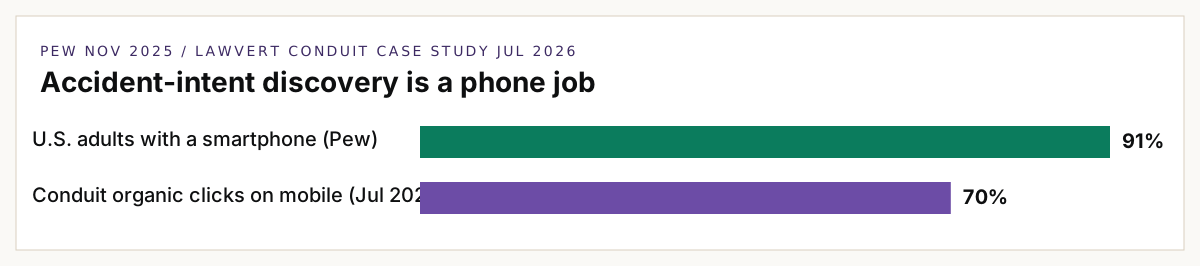
Accident hire queries happen on phones. A PI landing page that is a desktop brochure is a leak. This is not a map-pack lesson and not a full Core Web Vitals census.
How widely do U.S. adults own smartphones, and how many are smartphone-only for internet?
Pew is a cross-population floor, not an accident-search incidence rate.
- 98% of U.S. adults own a cellphone of some kind (Pew Research Center, Nov 2025).
- 16% of U.S. adults are smartphone-only internet users: they own a smartphone but have no home broadband (Pew Research Center, Nov 2025).
- The 2025 figures come from Pew's National Public Opinion Reference Survey of 5,022 U.S. adults, fielded 5 February through 18 June 2025 (Pew Research Center, Nov 2025).
- Smartphone ownership is 97% among ages 18-29 and 78% among ages 65 and older (Pew Research Center, Nov 2025).
- Smartphone ownership is 82% in households under $30,000 and 97% in households of $100,000 or more (Pew Research Center, Nov 2025).
- Rural adults are at 87% smartphone ownership versus 93% suburban (Pew Research Center, Nov 2025).
- Smartphone-only internet use is 27% among ages 18-29 and 34% among households under $30,000 (Pew Research Center, Nov 2025).
- Pew's first smartphone-ownership reading, in 2011, was 35% (Pew Research Center, Nov 2025).
What share of Conduit Law's peak-month organic clicks arrived on mobile?
One PI firm, one July, public Search Console device split. Prefer this over inventing "X% of PI searches are mobile."
- July 2026 also recorded 610 desktop clicks and 17 tablet clicks on the same property (LawVert, Jul 2026).
- 2,000 of those July clicks came from the United States (LawVert, Jul 2026).
What share of local law firm sites pass Core Web Vitals on mobile in a competitive CrUX sample?
One tease. Website-as-product depth, script stacks, and forms/chat census belong on law firm website statistics. Frame here as mobile PI landing feel after the organic click.
- Of 186 local law firms ranking for practice-area-plus-city queries across 32 U.S. metros (CrUX, May 2026 mobile), 48.4% pass Core Web Vitals (PageSpeed Matters, Jul 2026).
- Good INP was 96.2% and good CLS was 91.4%; loading is the weak vital, with good LCP at 74.2% and median LCP at 2.0 seconds (PageSpeed Matters, Jul 2026).
- 28.5% of those local sites lacked enough traffic for INP reporting, and a separate elite-national comparison set passed about 77% of the time (PageSpeed Matters, Jul 2026).
What happens after the organic click: site and intake failure?
Ranking a brochure that cannot explain hiring, then failing to answer the phone, is how PI organic dies. Clio's figures are all-practice, including a Grow-product cohort on intake lift. Attribute the cohort. Do not turn it into a LawVert ROI claim.
How many firms' sites give clear hiring-process guidance or pricing?
Organic traffic that lands on a site with no hiring path is a measurement success and a business failure.
- Just 30% of law firm websites provide clear guidance on the hiring process (Clio, Oct 2024).
- 14% display pricing information (Clio, Oct 2024).
- 74% of surveyed lawyers use the firm website to promote or market services (Clio, Oct 2024).
- 86% of prospective clients said it was easy to find the types of cases a firm handles on the website, so the gap is process and price, not practice-area labeling (Clio, Oct 2024).
How often do secret-shopped firms answer the phone or email?
This is first-touch failure after the click, not a paid-lead problem.
- Clio's 2024 secret shop contacted 500 U.S. firms from 20 June to 5 July 2024 (Clio, Oct 2024).
- Only 40% answered the phone, down from 56% in 2019 (Clio, Oct 2024).
- Including callbacks, only 52% were reachable by phone, so 48% were unreachable (Clio, Oct 2024).
- Of firms emailed, only 33% responded; 67% did not respond at all (Clio, Oct 2024).
- 84% of email responders replied within eight hours (Clio, Oct 2024).
- 73% of shoppers were unlikely to recommend the firms they contacted (Clio, Oct 2024).
- Only 2% of 2024 firms referenced similar legal situations the shoppers asked about, down from 27% in 2019 (Clio, Oct 2024).
- Voicemail response fell from 43% of firms in 2019 to 20% in 2024 (Clio, Oct 2024).
What lead and revenue lift shows up when firms use client-facing online intake capabilities?
Quote the PDF percentages. Press often rounds to 50/50. This is Clio research on a product cohort, not a universal guarantee and not Firm Brain copy.
- Firms using studied client-facing capabilities (online schedulers, online search ads, online intake forms, and related features) saw 51% more client leads and 52% higher revenues than firms not using those capabilities (Clio, Oct 2024).
- A 2020 Clio analysis found firms using dedicated client intake software saw as much as 20% more cases and earned 26% more revenue than firms not using the software (Clio, Oct 2024).
- 51% of clients find chatbots useful for exploring legal options, and 67% still prefer the ability to speak with a human when needed. That is intake-channel preference, not an AI-usage rate (Clio, Oct 2024).
Organic clicks that die at the phone are not an SEO win. Book a 15-minute strategy call if the missing number is the signed case.
What outcomes look like when PI organic reaches signed cases?
Public proof on LawVert is the Conduit Law case study only. Historical one-firm PI results. Not a promise of future clicks, leads, rankings, or signed cases. Zero-click and AI Overview depth belongs on law firm SEO statistics.
What public Search Console, location and practice stack, mobile share, and SEO-attributed signed figures does LawVert publish for Conduit Law?
Cite the case study. Do not invent pack-share, ROAS, or settlement math.
- Property `sc-domain:conduit.law`, web search 13 October 2025 through 21 August 2026: 7.61K Google clicks, 2.0M impressions, 0.4% CTR, average position 23.9 (LawVert, Aug 2026).
- Monthly clicks were 224 in December 2025 and 1,070 in June 2026, a 9.2 times increase from December to July (LawVert, Jul 2026).
- Trailing year ending 25 August 2026: 162 organic-search leads (LawVert, Aug 2026).
- The published stack is 668+ indexed pages, 25 practice areas, and 91 blog posts across 4 states (LawVert, Sep 2026).
- Major templates carry Organization, LegalService, FAQPage, and BreadcrumbList schema (LawVert, Sep 2026).
- July's highest-click URL was the settlement calculator at 811 clicks (LawVert, Jul 2026).
- These figures are historical results for one firm and are not a promise of future clicks, leads, or signed cases (LawVert, Sep 2026).
How much organic click share is left in Google search?
One tease. National SERP economics, AI Overview CTR, and open-web clicks-per-1,000 live on law firm SEO statistics.
- In January through April 2026, 68.01% of U.S. Google searches ended without a click (SparkToro analysis of Similarweb clickstream). That is a search-wide zero-click rate, not a PI-query CTR (SparkToro, Jun 2026).
- The same series put U.S. zero-click searches at 60.45% in 2024 (SparkToro, Jun 2026).
What does Search Console measure for organic programs?
A measurement floor. Not a LawVert benchmark, not a signed-retainer report, and not a ranking guarantee.
- Search Console performance reports cover how often users saw your site in Search (impressions), clicked (clicks), and which pages (Search Console Help, Sep 2026).
- Clicks are the number of times a user clicked your site from Google Search results; impressions are how many times your site appeared (Search Console Help, Sep 2026).
- CTR is clicks divided by impressions; average position is the average position of the topmost result from your site (Search Console Help, Sep 2026).
- The report can be grouped by queries, pages, countries, devices, search appearance, and dates (Search Console Help, Sep 2026).
- Google Search works in three stages (crawling, indexing, serving), and not all pages make it through each stage (Google Search Central, Dec 2025).
Book a 15-minute strategy call. Bring the markets you serve and the practice pages that take the case. Public proof remains the Conduit case study only.
Methodology and Sources
Every number traces to the organization that produced it: NHTSA crash and injury tables, FHWA Traffic Volume Trends (with FRED as a republished series host), Google Search Central spam and helpful-content documentation, the Search Quality Rater Guidelines PDF, Search Console Help, Ahrefs' provider pricing poll, Clio's 2024 Legal Trends Report and press summary, Pew's mobile fact sheet, LawVert's public Conduit case study, plus limited teases from WordStream (auction intensity), PageSpeed Matters (mobile landing feel), and SparkToro (zero-click). Aggregator PI SEO listicles, agency "$100-$300 PI CPC" tables, First Page Sage ROI, and invented mill percentages are not sources. NHTSA injured counts are not searchers. VMT is not query volume. Google floors are rules, not incidence. Ahrefs is seller pricing. Clio is all-practice, with intake lift measured on a product cohort. Conduit is one-firm historical proof. This page is refreshed monthly. Accessed 9 September 2026.
Article Sources
- NHTSA, Overview of Motor Vehicle Traffic Crashes in 2024 (DOT HS 813 791) Accessed September 9, 2026. ↩
- NHTSA DOI 10.21949/grds-1877 Accessed September 9, 2026. ↩
- FHWA Traffic Volume Trends hub Accessed September 9, 2026. ↩
- FHWA Traffic Volume Trends, February 2026 (PDF) Accessed September 9, 2026. ↩
- FHWA Traffic Volume Trends, March 2026 (PDF) Accessed September 9, 2026. ↩
- FHWA Traffic Volume Trends, July 2026 (PDF) Accessed September 9, 2026. ↩
- FRED, Vehicle Miles Traveled (TRFVOLUSM227NFWA) Accessed September 9, 2026. ↩
- Google Search Central, Spam policies for Google web search Accessed September 9, 2026. ↩
- Google Search Central, Creating helpful, reliable, people-first content Accessed September 9, 2026. ↩
- Google Search Central, SEO Starter Guide Accessed September 9, 2026. ↩
- Google Search Central, How Google Search works Accessed September 9, 2026. ↩
- Google Search Blog, March 2024 core update and new spam policies Accessed September 9, 2026. ↩
- Google Search Blog, Search Quality Raters Guidelines update Accessed September 9, 2026. ↩
- Search Quality Rater Guidelines (11 September 2025 PDF) Accessed September 9, 2026. ↩
- Search Console Help, How are you performing on Google? Accessed September 9, 2026. ↩
- Search Console Help, Performance report overview Accessed September 9, 2026. ↩
- Ahrefs, SEO Pricing: How Much Does SEO Cost? 439 People Polled Accessed September 9, 2026. ↩
- Clio 2024 Legal Trends Report (PDF) Accessed September 9, 2026. ↩
- Clio, latest Legal Trends Report press summary Accessed September 9, 2026. ↩
- Pew Research Center, Mobile Fact Sheet Accessed September 9, 2026. ↩
- LawVert, Conduit Law case study Accessed September 9, 2026. ↩
- WordStream, Google Ads Benchmarks 2026 Accessed September 9, 2026. ↩
- PageSpeed Matters, Law Firm Website Speed Accessed September 9, 2026. ↩
- SparkToro, In 2026 less than one third of Google searches still send a click Accessed September 9, 2026. ↩
Glossary
- SEO: Search engine optimization, the work of making unique, crawlable pages that can appear in unpaid Google results.
- Organic vs paid: Organic is unpaid search. Paid is ads. This hub is organic. CPC depth is the ads stats hub.
- Doorway page: Pages created to rank for specific similar queries and funnel users to a destination, including city-targeted copies of the same page.
- Scaled content abuse: Generating many pages primarily to manipulate rankings, including AI or human mill output that adds little value.
- YMYL: Your Money or Your Life. Topics that could significantly affect health, financial stability, safety, or societal welfare.
- E-E-A-T: Experience, Expertise, Authoritativeness, and Trustworthiness. A rater concept and quality frame, not a single ranking factor.
- VMT: Vehicle miles traveled. FHWA's national driving-volume series. Not search volume.
- CrUX / CWV: Chrome UX Report field data and Core Web Vitals (LCP, INP, CLS). Teased here; website hub owns depth.
- AIO / zero-click: AI Overviews and searches that end without a click to the open web. Teased here; law-firm SEO stats hub owns depth.
- GSC: Google Search Console. Impressions, clicks, pages, devices. A measurement floor.
- RPC: Rules of Professional Conduct. Public copy on LawVert stays RPC 7.1-safe: no ranking guarantees, no invented case results.
- CPL vs signed case: Cost per lead is an in-platform conversion. A signed case is a retainer. Do not equate them.
- Primary source: The organization that originally produced the data or the rule text.
- Aggregator: A page that republishes other people's stats without producing the data.
Related LawVert reading
After fail modes, cost, and intake
Organic clicks still fail at the page and the phone
If the report stops at rankings, the missing number is the signed case. Public proof is only the Conduit Law case study. We do not publish a universal SEO ROI.
Book a callNext step
Bring the markets and the pages that take the case
Book a 15-minute strategy call. The stats describe the gap. The call is whether LawVert under Cadence MSO is a fit. No ranking promise. No invented case results.
Book a callPrefer to email first? hello@lawvert.com · Send a note