Law firm website statistics
146 Law Firm Website Statistics 2026
Primary sources only. The site is a product: incidence, speed, trust, forms, and intake. Not a ranking essay. Not a spend mix.
Updated SEPTEMBER 2026
Written by Jonathan Mahler, reviewed by Jonathan Mahler. Operator notes, not legal advice.
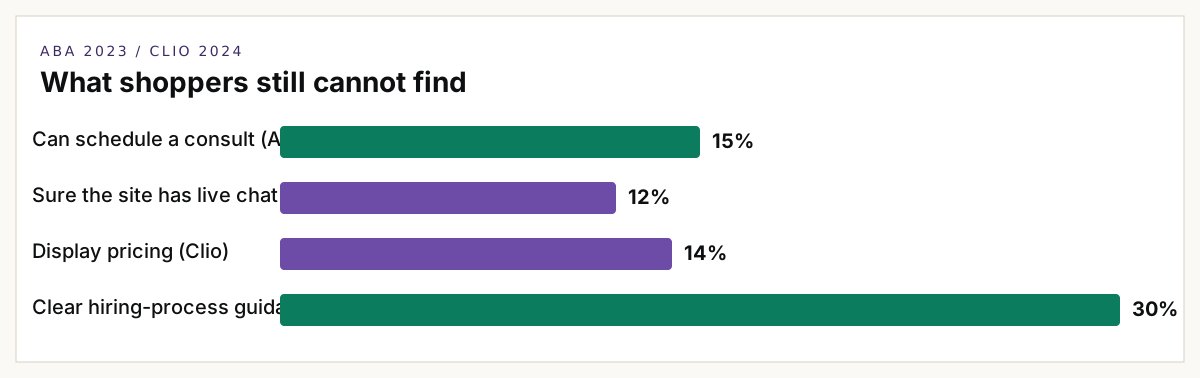
Most firms treat the website as a brochure they already finished. The product is still incomplete. 74% of surveyed lawyers currently use their firm website to promote or market services to potential clients (Clio, Oct 2024). Shoppers can usually find a phone number. They cannot find the hiring path: just 30% of law firm websites provide clear guidance on the hiring process, and 14% display pricing information (Clio, Oct 2024).
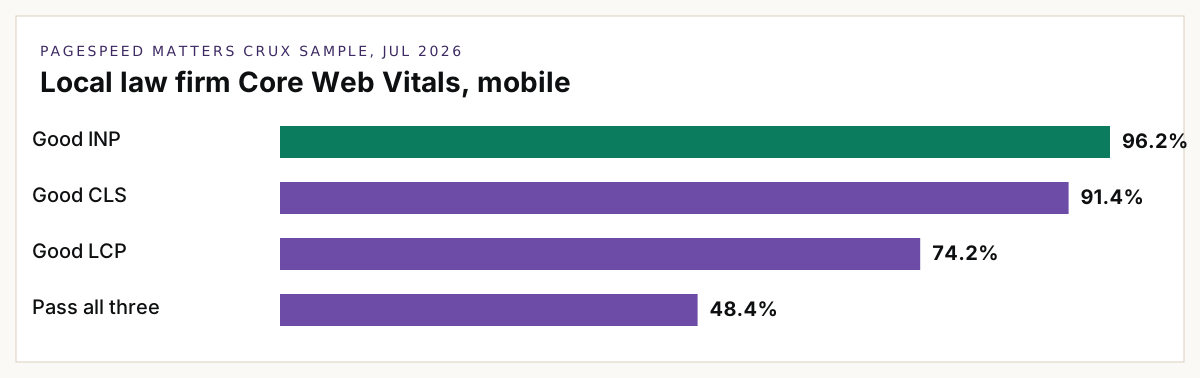
Speed is part of that product, not a ranking parlor trick. In a Chrome UX Report field sample of 186 local law firms ranking for practice-area-plus-city queries across 32 U.S. metros (mobile, 75th percentile, May 2026), only 48.4% pass Core Web Vitals (PageSpeed Matters, Jul 2026). That is a competitive-search sample, not a census of every firm site, and it is not personal-injury-only. Cross-practice figures on this page stay labeled that way.
This URL is the citation ledger for the site as a product: incidence, on-site gaps, script weight, trust signals, forms/chat/scheduling, and what happens when the asset wires to intake. The commercial how-to lives on law firm website design. SERP, AI Overview, and zero-click depth belong on law firm SEO (and the sibling `/law-firm-seo-statistics` hub). Spend and channel mix belong on law firm marketing (and `/law-firm-marketing-statistics`). Google Business Profile and map-pack ranking factors belong on a future `/law-firm-local-seo-statistics` page, not here. Updated September 2026.
Key Takeaways
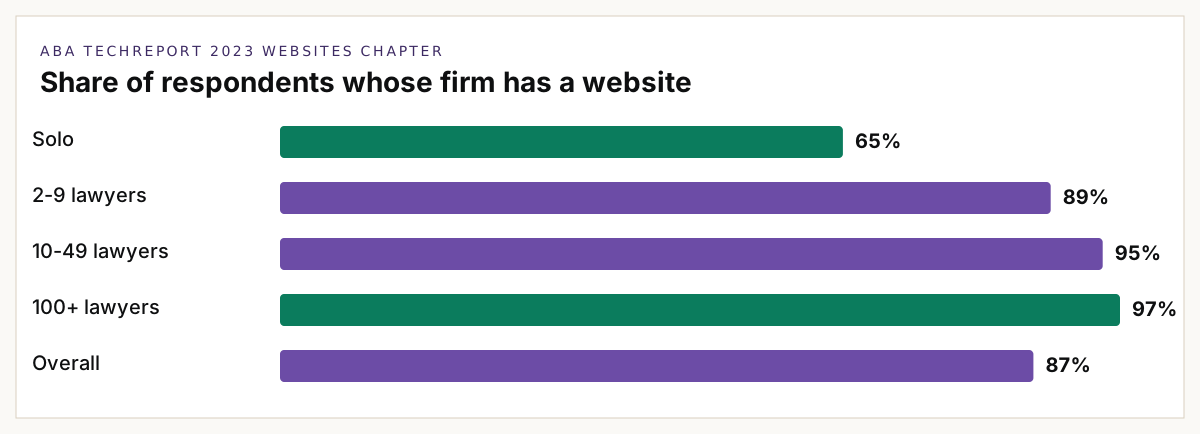
- 87% of ABA Legal Technology Survey respondents in the 2023 websites chapter said their firm has a website, down from 94% in 2021 and 2022 (ABA, Jan 2024).
- Only 44% of those respondents said the firm site uses SSL / HTTPS. Another 48% did not know (ABA, Jan 2024).
- Partner profiles appear on 96% of respondents' firm websites. Associate profiles appear on 74% (ABA, Jan 2024).
- Only 15% of respondents said the firm website offered the ability to schedule an initial consultation (ABA, Jan 2024).
- 81% of respondents' firms do not offer live chat. Only 12% were sure the site did (ABA, Jan 2024).
- Fillable forms for document creation appear on 5% of respondents' firm websites (ABA, Jan 2024).
- Across 303 law firm homepages, the average page loads 10.9 scripts: 8.7 first-party and 2.2 third-party (Constellate, Jan 2025).
- Google Tag Manager appears on 32.7% of those homepages, the most common third-party domain in the crawl (Constellate, Jan 2025).
- Local firms fail Core Web Vitals on loading, not taps or layout: good LCP is 74.2%, the weakest of the three metrics, and median LCP is 2.0 seconds. PageSpeed Matters attributes the local failures to marketing-stack weight (video, widgets, tracking), not interaction or stability (PageSpeed Matters, Jul 2026).
- 89.1% of the Constellate sample load five or fewer third-party scripts in the initial HTML (Constellate, Jan 2025).
- Only 35% of ABA respondents reported having a client retain them directly through the firm website, up from 25% in 2022 (ABA, Jan 2024).
- Only about one third of respondents said website forms include disclaimers on security, privilege, or whether an attorney-client relationship is formed (ABA, Jan 2024).
- 74% of respondents say the firm site is mobile-friendly. Another 20% do not know (ABA, Jan 2024).
- TrustIndex review widgets load from `cdn.trustindex.io` on 7.3% of the Constellate homepages, the fourth-most-common third-party domain (Constellate, Jan 2025).
How widely do firms treat the website as their promo channel?
Having a URL is not the same as running a site as a product. ABA incidence is self-report from private-practice attorneys. Clio's 74% figure is claimed promo use. Neither is a crawler census, and neither is PI-only.
What share of firms report having a website (ABA TechReport)?
The 2023 websites chapter is the last full ABA table that still shows a dip. The 2024 update recovered some of it, especially among solos. Large firms were already at the ceiling.
- The 2023 overall 87% rate matches the 2020 reading after two years at 94% (ABA, Jan 2024).
- Solos were the gap: 65% of solo respondents reported a website (ABA, Jan 2024).
- Firms of 2-9 lawyers: 89% (ABA, Jan 2024).
- Firms of 10-49 lawyers: 95% (ABA, Jan 2024).
- Firms of 100 or more lawyers: 97% (ABA, Jan 2024).
- In the 2024 websites chapter, 90% of respondents report having a website, down from 94% in 2022 (ABA, Apr 2025).
- Solo website incidence rose to 70% in 2024, up from 61% in 2022 (ABA, Apr 2025).
- 100% of respondents at firms of 100+ attorneys reported a website in 2024 (ABA, Apr 2025).
- The 2024 Practice Management TechReport repeats the same survey volume and adds mid-size rows: 91% of firms with 2-9 attorneys and 98% of firms with 10-49 (ABA, Apr 2025).
- The 2024 Solo and Small Firm TechReport notes solo website incidence grew from 53% in 2021 to 70% in 2024 (ABA, Apr 2025).
- 2023 survey respondents were 22% solo, 30% at firms of 2-9, 21% at 10-49, 6% at 50-99, 11% at 100-499, and 10% at 500 or more (ABA, Jan 2024).
How many lawyers say the firm website is a primary promo channel (Clio)?
Claimed promo use is high. The information shoppers can actually extract is the next section. Clio's Legal Trends Report is a product-cohort research program, not a random census of every U.S. firm.
- 86% of prospective clients agreed it is easy to find information on the types of cases a law firm deals with on the website (Clio, Oct 2024).
- Clio still reports that shoppers struggled to understand the step-by-step process of hiring or working with a lawyer, or to find pricing, even when contact information was visible (Clio, Oct 2024).
Who manages the site and creates its content (ABA)?
The operator split is the wedge. ABA does not measure "percent of firms on managed hosting." It measures who the respondent thinks runs the asset.
- Website management in 2023 split three ways: outside consultants or providers 24%, one lawyer in the firm 21%, and firm marketing staff 20% (ABA, Jan 2024).
- 60% of solos with sites say one lawyer manages the site (ABA, Jan 2024).
- Another 30% of solos use outside consultants to manage the site (ABA, Jan 2024).
- At firms of 2-9 lawyers, outside providers manage 40% of sites and one lawyer manages 30% (ABA, Jan 2024).
- Content created by more than one lawyer fell to 44% in 2023, from 56% in 2022 (ABA, Jan 2024).
- Firm marketing staff created website content at 31% of respondents' firms, down from 43% in 2022 (ABA, Jan 2024).
- Outside consultants created content for 24% of respondents' firm websites (ABA, Jan 2024).
- One lawyer created the content at 21% of firms, up from about 15% over the prior two years (ABA, Jan 2024).
- 72% of solos with websites create their own content (ABA, Jan 2024).
- At firms of 100 or more attorneys, 79% report marketing staff create website content and 63% report more than one lawyer does (ABA, Jan 2024).
- Among firms that hire an outside consultant or agency, website design is the most common assignment at 42% (ABA, Jan 2024).
- The 2024 Solo and Small Firm TechReport finds 76% of solo attorneys and 63% of small-firm attorneys personally manage and create content for the firm website (ABA, Apr 2025).
Where do firm websites fail visitors before intake?
A site that cannot explain the hire, and a firm that does not pick up after the click, is the same broken product. Clio's secret shop is behavioral. CallRail is self-reported loss on calls, texts, and webforms. Neither is a PI-only census. Zero-click and AI Overview click-share tables stay on the SEO statistics hub.
How many firm sites give clear hiring-process guidance or pricing (Clio)?
The 30% / 14% pair is the site-as-product failure. The rest of the shopper path is contact info without a process.
- Clio's press summary of the 2024 Legal Trends Report is the origin for that hiring-process and pricing pair (Clio, Oct 2024).
- Firms may hesitate to publish fees because services vary. Clio's own narrative is that more information up front is still the shopper request (Clio, Oct 2024).
How often do secret-shopped firms answer the phone or email after a site visit path?
Clio hired a third-party shop to contact 500 U.S. law firms from June 20 to July 5, 2024 via email, phone, chatbot, and intake form (Clio, Oct 2024).
- Only 40% of firms tested in 2024 answered the first phone call, down from 56% in 2019 (Clio, Oct 2024).
- Including callbacks, only 52% were reachable by phone, so 48% were unreachable (Clio, Oct 2024).
- In 2019, 73% of phoned firms either picked up or called back (Clio, Oct 2024).
- 67% of firms emailed in 2024 did not respond at all, versus 60% non-response in 2019 (Clio, Oct 2024).
- Of firms that did reply to email, 84% did so within eight hours (Clio, Oct 2024).
- On the phone, only 41% offered rate information, 12% a cost estimate, and 36% explained process or next steps (Clio, Oct 2024).
- 73% of shoppers were unlikely to recommend the firms they contacted (Clio, Oct 2024).
- Voicemail response fell from 43% of firms in 2019 to 20% in 2024 (Clio, Oct 2024).
- Only 2% of 2024 email replies referenced similar legal situations or case law, down from 27% in 2019 (Clio, Oct 2024).
How many firms say slow responses to calls, texts, or webforms have cost them cases (CallRail)?
CallRail sells call tracking and intake tools. Treat the survey as a vendor sample with a mid/large-firm skew, not a census.
- CallRail surveyed 100 U.S. law firms in October 2025 at a 95% confidence level with a plus-or-minus 5% margin of error (CallRail, Oct 2025).
- 81% say they have lost business due to slow responses to inbound calls, texts, or webforms (CallRail, Oct 2025).
- 35% say they lost significant business, up to 11-25% of revenue (CallRail, Oct 2025).
- Phone and email were each cited by 69% of firms as first-contact channels (CallRail, Oct 2025).
- 36% say text messages are a first-contact channel (CallRail, Oct 2025).
- Only 22% use fundamental tools like call tracking and recording (CallRail, Oct 2025).
- Respondents were 43% executive leadership, 25% marketing, and 22% operations (CallRail, Oct 2025).
- Inside the firm, leading intake-adjacent challenges include sales and customer-service training (59%), lead follow-up and conversion (50%), and appointment scheduling (46%) (CallRail, Oct 2025).
- Firms with dedicated intake staff were less likely to report lost business due to missed calls (34% compared with 52% overall) (CallRail, Oct 2025).
If the site path dies at the phone, book a 15-minute strategy call. Public proof of a crawlable site wired to intake is only the Conduit Law case study. That is one firm, not a conversion-rate promise.
How do law firm sites perform as products: speed and script weight?
The legal CrUX sample and the Constellate script crawl are the two origin datasets this hub owns. They are different samples. Do not blend them into one causal study. Ranking-system essays and deep Almanac trend tables live on law firm SEO.
What share of local law firm sites pass Core Web Vitals in a CrUX field sample (PageSpeed Matters)?
Passing requires all three metrics at the 75th percentile on mobile: LCP under 2.5 seconds, INP under 200 milliseconds, and CLS at or below 0.1.
- Core Web Vitals should be measured at the 75th percentile of page loads, mobile and desktop. A page passes only if all three metrics meet the recommended targets at that percentile (web.dev, Oct 2024).
- Largest Contentful Paint should occur within 2.5 seconds of when the page starts loading (web.dev, Oct 2024).
- Interaction to Next Paint should be 200 milliseconds or less. Cumulative Layout Shift should stay at 0.1 or less (web.dev, Oct 2024).
- Google's ranking systems use Core Web Vitals. Good scores in Search Console or third-party tools are not a ranking guarantee (Google Search Central, Dec 2025).
- There is no single "page experience signal." Core ranking systems look at a variety of signals that align with overall page experience (Google Search Central, Dec 2025).
- In the local legal sample, good INP is 96.2% and good CLS is 91.4%, so taps and layout are not the failure mode (PageSpeed Matters, Jul 2026).
- 28.5% of the local firm sites lack enough traffic for INP reporting. Under the strict all-three rule those origins do not pass (PageSpeed Matters, Jul 2026).
- In a separate elite-national comparison set, about 77% of major firms pass. PageSpeed Matters describes those sites as light prestige brochures rather than lead-gen stacks (PageSpeed Matters, Jul 2026).
- The slowest local firms load in 5 seconds or more, driven by heavy homepage video and stacked marketing scripts (PageSpeed Matters, Jul 2026).
- The readings come from Chrome UX Report field data for May 2026, not a lab run (PageSpeed Matters, Jul 2026).
- The study covers 186 local law firms across 32 U.S. metros, built from practice-area-plus-city search results (PageSpeed Matters, Jul 2026).
- PageSpeed Matters is explicit that this is a competitive-search set by design, not an attempt to catalog every law firm website (PageSpeed Matters, Jul 2026).
- The diagnosis on origin: defer marketing tags and live-chat so they load after content, replace full-screen homepage video with a static or lazy-loaded image, and compress hero imagery. That keeps the lead-gen toolkit without blocking first paint (PageSpeed Matters, Jul 2026).
- Matt Suffoletto published the study on July 16, 2026 as part of PageSpeed Matters' Website Speed by Industry 2026 research (PageSpeed Matters, Jul 2026).
How heavy is the average law firm homepage script / third-party marketing stack (Constellate)?
Constellate crawled 303 law firm homepages drawn from Google Maps top results in 25 mid-size U.S. markets. The crawl is static HTML only, so GTM-injected runtime scripts are undercounted. Constellate sells a performance CMS. Attribute the vendor.
- Last updated January 18, 2025. Original research by Constellate (Constellate, Jan 2025).
- 123 unique third-party domains appear across the 303 sites (Constellate, Jan 2025).
- The average site connects to 1.6 unique external domains (Constellate, Jan 2025).
- Only 2% of sites load more than 10 third-party scripts in the initial HTML (Constellate, Jan 2025).
- Distribution: 270 sites (89.1%) load 0-5 third-party scripts; 27 sites (8.9%) load 6-10 (Constellate, Jan 2025).
- Four sites (1.3%) load 11-15 third-party scripts. One site (0.3%) loads 16-20. One site (0.3%) loads 20 or more (Constellate, Jan 2025).
- `google.com` appears on 18.8% of sites (57 of 303) (Constellate, Jan 2025).
- CallRail's CDN (`cdn.callrail.com`) appears on 15.8% of sites (48 of 303) (Constellate, Jan 2025).
- Scorpion analytics (`analytics.scorpion.co`) appears on 5.6% of sites (17 of 303) (Constellate, Jan 2025).
- `cdnjs.cloudflare.com` appears on 4.3% of sites (13 of 303) (Constellate, Jan 2025).
- `ajax.googleapis.com` appears on 2.6% (8 sites). `cdn.jsdelivr.net` and CallTrackingMetrics (`cdn.calltrk.com`) each appear on 2.3% (7 sites) (Constellate, Jan 2025).
- `img1.wsimg.com` and `code.jquery.com` each appear on 2.0% (6 sites) (Constellate, Jan 2025).
- Hibu (`static-res-cdn.websites.hibu.com`), `dh-static-files.s3.amazonaws.com`, `static.cdn-website.com`, and `analytics.ahrefs.com` each appear on 1.7% (5 sites) (Constellate, Jan 2025).
- The "other" category is 69.7% of identifiable third-party loads (468 of the categorized scripts): CDN libraries, widgets, and platform code (Constellate, Jan 2025).
- Analytics is 23.8% of third-party loads (160 scripts). CMS / platform is 5.4% (36). Ads are 0.6% (4). Social is 0.3% (2). Chat is 0.1% (1). Legal / consent scripts in the initial HTML are 0.0% (Constellate, Jan 2025).
- The top five domains account for more than 80% of all third-party script loads (Constellate, Jan 2025).
- Google Tag Manager, Google properties via `google.com`, and CallRail together appear on more than 67% of sites that load any third-party script (Constellate, Jan 2025).
- GTM itself is a container. 99 of 303 sites (32.7%) load the container in initial HTML. Runtime tags injected after that are not in this crawl (Constellate, Jan 2025).
What share of the open web passes CWV in the HTTP Archive Almanac?
This is a cross-web twin, not a legal census. Do not average it with the 186-firm CrUX sample. Depth on CWV as a ranking signal belongs on law firm SEO and the `/law-firm-seo-statistics` hub.
- In the 2025 Web Almanac Performance chapter (primary analysis July 2025 CrUX / HTTP Archive), 48% of mobile and 56% of desktop websites achieve "good" Core Web Vitals on all three metrics (HTTP Archive, May 2026).
- That is up from 44% mobile / 55% desktop in 2024, and from 36% mobile / 48% desktop in 2023 (HTTP Archive, May 2026).
- Mobile LCP "good" is 62%. Desktop LCP "good" is 74% (HTTP Archive, May 2026).
- For phones, 77% of websites have good INP, 21% need improvement, and 3% are poor. Desktop good INP is 97% (HTTP Archive, May 2026).
- Mobile INP good share rose from 74% in 2024 to 77% in 2025 (HTTP Archive, May 2026).
- The chapter was published January 15, 2026 and last updated May 5, 2026 (HTTP Archive, May 2026).
What trust and security signals appear on firm sites?
ABA trust figures are self-report. 48% "don't know" on SSL is the awareness gap, not a crawler HTTPS census. Schema incidence below is web-wide, not "% of law firms with LegalService."
How many respondents say the firm site uses HTTPS / SSL (ABA)?
Self-report plus a large don't-know bucket. Pair it with the commercial hub's crawlable / HTTPS floor. Do not treat 44% as the share of firm sites that actually serve HTTP.
- The 2023 websites chapter is the origin for the SSL awareness split (ABA, Jan 2024).
- Google Search Central still asks whether pages are served in a secure fashion as part of page-experience hygiene, separate from Core Web Vitals scores (Google Search Central, Dec 2025).
How common are attorney bios and form-disclaimer hygiene on firm sites (ABA)?
Bios are near-universal. Conversion copy and disclaimer hygiene are not. Bios are not an E-E-A-T guarantee.
- Recent firm successes appear on 47% of respondents' sites, down from 57% the prior year (ABA, Jan 2024).
- In-house legal articles appear on 54%, down from 62% in 2022 (ABA, Jan 2024).
- Consumer guides written in-house appear on only 15% of sites (ABA, Jan 2024).
- Cases of interest appear on 37% (ABA, Jan 2024).
- 64% of respondents' firms still do not syndicate website content. Of the 14% who do, 63% syndicate on social media and 24% on Law360 (ABA, Jan 2024).
- Mobile-friendly self-report by size: 80% at firms of 100 or more, 75% at 2-9, 69% at 10-49, and 68% of solos (ABA, Jan 2024).
- Another third of respondents do not know whether forms carry those disclaimers. 8% said the firm provides no disclaimers. 27% said the firm does not collect information through text fields (ABA, Jan 2024).
- Names are collected on 90% of sites that gather information, telephone numbers on 73%, email addresses on 42%, and mailing addresses on 37% (ABA, Jan 2024).
How common is structured data / JSON-LD web-wide (Web Data Commons)?
Web-wide crawl. Not a law-firm LegalService census. Frame it as the machine-readable trust floor the commercial templates already require. Schema ranking depth belongs on law firm SEO.
- The October 2024 Common Crawl extract found structured data on 51.25% of examined HTML pages (1.3 billion of 2.4 billion) (Web Data Commons, Oct 2024).
- Those pages come from 16.5 million pay-level domains out of 37.5 million in the crawl (44.12%) (Web Data Commons, Oct 2024).
- The extracted datasets contain 74 billion RDF quads (Web Data Commons, Oct 2024).
- JSON-LD appears on about 11.5 million websites (11,562,359 domains in the extractor table) (Web Data Commons, Oct 2024).
- Microdata appears on 7.6 million websites (University of Mannheim, Jan 2025).
- Among sites that annotate structured data, JSON-LD is used by about 70%. Microdata is used by 46% (University of Mannheim, Jan 2025).
- schema.org LocalBusiness annotations grew from 231,000 websites in 2017 to about 1.5 million in 2024, a 649% increase. That is web-wide LocalBusiness, not LegalService (University of Mannheim, Jan 2025).
- In 2010, only 5.7% of examined pages contained structured data (University of Mannheim, Jan 2025).
How common are conversion surfaces: forms, chat, and scheduling?
Incidence of offering a widget is not a completion rate. ABA is self-report. Clio chatbot figures are a small-n preference companion. Do not read them as a LawVert chatbot pitch, and do not center industry AI-adoption headlines here.
What share of firms offer online consultation scheduling on the website (ABA)?
The consult button is rare. Existing-client calendars are only slightly more common, and barely moved since 2019.
- Solos: 20% offered initial-consultation scheduling. Firms of 2-9: 17%. Firms of 10-49: 10%. Firms of 50-99: 18% (ABA, Jan 2024).
- Beyond intake, only 21% offered clients online calendar or appointment scheduling, versus 23% in 2019 (ABA, Jan 2024).
- The 2024 Solo and Small Firm TechReport finds solos at 23% and small firms at 18% allowing online scheduling, versus 15% at 100+ attorney firms and 14% at firms of 10-49 (ABA, Apr 2025).
How common is live chat or chatbot on firm sites, and what do clients prefer (ABA + Clio)?
ABA measures live-chat incidence. Clio measures chatbot adoption and shopper preference. Keep them labeled.
- Where live chat is offered, a virtual receptionist handles it at 47% of those firms (down from 63% in 2022), one attorney at 29%, paralegals at 15%, and an in-house receptionist at 12% (down from 25% in 2022) (ABA, Jan 2024).
- Only 7% of law firms currently use chatbots on their websites. Similarly, 7% of lawyers believe clients would prefer chatbot communication (Clio, Oct 2024).
- 51% of prospective clients agree chatbots can be useful for exploring legal options. 67% still prefer the ability to speak with a human (Clio, Oct 2024).
- One in six potential clients has used an AI-powered chatbot to obtain legal resources (Clio, Oct 2024).
How common are fillable forms and call-tracking tools that preserve source into intake (ABA + CallRail)?
Forms that collect a name without source parameters are not an intake system. CallRail's 22% tracking figure is the vendor survey, not an ABA census.
- Document sharing is offered by 48% of respondents. 45% said they do not offer it. Solos are least likely, at 36% (ABA, Jan 2024).
- Solos are the most likely to report fillable document-creation forms, at 24% (ABA, Jan 2024).
- Online invoicing or bill pay is offered by 41%, up from 34% in 2019 (ABA, Jan 2024).
- 53% of respondents said the firm does not offer a secure client portal (ABA, Jan 2024).
- 35% said the firm offers a secure client portal. Only 12% regularly use it to communicate with clients. Another 24% use it only occasionally (ABA, Jan 2024).
- Portal offer rates rise with size: 25% of solos, about 31% at firms of 2-49, 41% at 50-99, 50% at 100-499, and 66% at 500 or more (ABA, Jan 2024).
- Of firms that offer a portal, 22% use SharePoint, 21% Clio, 12% NetDocs, 11% a custom solution, and 10% MyCase (ABA, Jan 2024).
Conversion surfaces without a staffed path still fail. Book a 15-minute strategy call if you want the site, the form, and the phone looked at as one system.
What outcomes look like when the website connects to intake?
Lift studies are not LawVert ROI. ABA retention-via-website is self-reported attribution, not analytics. Conduit is one public property.
What lead and revenue lift shows up when firms use client-facing online intake capabilities (Clio)?
Clio looked at Clio Grow users of studied client-facing capabilities (online schedulers, online search ads, online intake forms, text messaging, and related tools). That is a product cohort.
- Firms using those capabilities saw 51% more client leads and 52% higher revenues than firms not using them. Press often rounds this to "50% / 50%." Prefer the PDF pair (Clio, Oct 2024).
- Online schedulers, public online intake forms, and in-area search ads are the three site-adjacent levers Clio names in that cohort (Clio, Oct 2024).
- Press also rounds the same research to "50% more incoming potential clients and earn 50% more revenue on average" for firms that add online client intake tools (Clio, Oct 2024).
How often do respondents report a client retained directly through the firm website (ABA)?
Self-report. Another quarter does not know. Useful as a twin to Clio's intake cohort, not as a LawVert close rate.
- Another quarter of respondents do not know whether a client retained the firm as a result of the website (ABA, Jan 2024).
- One third of respondents say their law firms have a blog, including 60% at firms of 100-499 lawyers and over 67% at firms of 500 or more (ABA, Jan 2024).
- Of those whose firms have blogs, 29% report a client retained directly or via referral from the blog, including 45% of solos who blog (ABA, Jan 2024).
- Of respondents who maintain their own legal-topic blogs, 53% said a client retained them directly or via referral as a result of that blogging (ABA, Jan 2024).
What public Search Console, stack, and SEO-attributed signed figures does LawVert publish for Conduit Law?
Proof card only. Historical results for one firm. Not a promise of future clicks, leads, conversion rate, or signed cases. Prefer the website-as-product hooks: mobile share, template stack, schema on templates. Click totals stay attributed to the case study.
- Property `sc-domain:conduit.law`, web search, October 13, 2025 through August 21, 2026: 7.61K Google clicks, 2.0M impressions, 0.4% CTR, average position 23.9 (LawVert, Aug 2026).
- Monthly clicks rose 9.2 times from December 2025 (224) to July 2026 (2,060) (LawVert, Aug 2026).
- Trailing year ending August 25, 2026: 162 organic-search leads and 66 SEO-attributed signed cases (LawVert, Aug 2026).
- Stack: 668+ indexed pages, 508 location pages, 25 practice areas, 91 blog posts (LawVert, Aug 2026).
- In July 2026, 70% of clicks were mobile (1,440 mobile, 610 desktop, 17 tablet) (LawVert, Aug 2026).
- Major templates ship Organization, LegalService, FAQPage, and BreadcrumbList schema (LawVert, Aug 2026).
That is the public architecture pattern, not a typical conversion lift. Book a 15-minute strategy call if you want the same diagnostic against your current site. Bring the markets you want to add. No ranking promise.
Methodology and Sources
Every number traces to the organization that produced it: ABA Legal Technology Survey website chapters (self-report), Clio's 2024 Legal Trends Report (product-cohort research plus a 500-firm secret shop), CallRail's October 2025 vendor survey of 100 U.S. firms, PageSpeed Matters' May 2026 CrUX sample of 186 local firms, Constellate's static-HTML crawl of 303 Maps-visible homepages, the HTTP Archive Web Almanac (open-web CWV, not legal-vertical), Web Data Commons / University of Mannheim (open-web structured data, not LegalService incidence), web.dev and Google Search Central thresholds, and LawVert's public Conduit Law case study. Aggregator listicles are not sources. Conflicting definitions stay attributed. Cross-practice stats are labeled; they are not PI-only. Almanac and WDC are teased in one H3 each. This page is refreshed monthly. Accessed September 9, 2026.
Article Sources
- ABA, 2023 Websites & Marketing TechReport Accessed September 9, 2026. ↩
- ABA, 2024 Websites and Marketing TechReport Accessed September 9, 2026. ↩
- ABA, 2024 Solo and Small Firm TechReport Accessed September 9, 2026. ↩
- ABA, 2024 Practice Management TechReport Accessed September 9, 2026. ↩
- Clio, 2024 Legal Trends Report (PDF) Accessed September 9, 2026. ↩
- Clio, 2024 Legal Trends Report press release Accessed September 9, 2026. ↩
- CallRail, 2026 Legal Marketing Outlook Report (PDF) Accessed September 9, 2026. ↩
- PageSpeed Matters, Law Firm Website Speed Accessed September 9, 2026. ↩
- Constellate, Third-party script overhead on 303 law firm homepages Accessed September 9, 2026. ↩
- HTTP Archive, 2025 Web Almanac Performance Accessed September 9, 2026. ↩
- Web Data Commons, October 2024 structured-data stats Accessed September 9, 2026. ↩
- University of Mannheim, WDC 2024 corpus announcement Accessed September 9, 2026. ↩
- web.dev, Web Vitals Accessed September 9, 2026. ↩
- Google Search Central, Understanding page experience Accessed September 9, 2026. ↩
- LawVert, Conduit Law case study Accessed September 9, 2026. ↩
Glossary
- CWV: Core Web Vitals. Google's field metrics for loading (LCP), interactivity (INP), and visual stability (CLS).
- LCP: Largest Contentful Paint. Time until the main content paints. Good is 2.5 seconds or faster at the 75th percentile.
- INP: Interaction to Next Paint. Responsiveness after a click or tap. Good is 200 milliseconds or faster.
- CLS: Cumulative Layout Shift. Unexpected layout movement. Good is 0.1 or less.
- CrUX: Chrome User Experience Report. Real-user field data, not a lab test.
- HTTPS / SSL: Encrypted transport for the public site. ABA figures here are self-report, not a crawl.
- JSON-LD: A JSON-based format for embedding structured data. Google's recommended syntax.
- Schema: Vocabulary (often schema.org) that tells machines what a page is. Not a ranking cheat code.
- GTM: Google Tag Manager. A container that can inject more scripts at runtime.
- GSC: Google Search Console. The click and impression extract for Conduit Law is public on the case study.
- LTR: Clio Legal Trends Report.
- Intake: The path from first contact to a retained matter. A webform without source preservation is not finished intake.
- IA / UX: Information architecture and user experience of the public site.
- Primary source: The organization that originally produced the data.
- Aggregator: A page that republishes other people's stats without producing the data.
Related LawVert reading
After forms and intake
A brochure that cannot finish the call is not a website
If the report stops at having a URL, the missing number is whether a tired caller can finish the form with source intact. Public proof is only the Conduit Law case study. We do not publish a universal conversion rate.
Book a callNext step
Bring the site you have
Book a 15-minute strategy call. The stats describe the gap. The call is whether LawVert under Cadence MSO is a fit. No ranking promise. No invented case results.
Book a callPrefer to email first? hello@lawvert.com · Send a note