Law firm marketing statistics
201 Law Firm Marketing Statistics 2026
Primary sources only. Spend, channel mix, consumer path, and intake gaps. Not a PI auction table. Not an SEO vitals page.
Updated SEPTEMBER 2026
Written by Jonathan Mahler, reviewed by Jonathan Mahler. Operator notes, not legal advice.
Most firms still buy marketing as a stack of vendors. The primary data describes a system: a budget (or no budget), a channel mix that is still half traditional, a consumer who researches before they call, and an intake path that drops the people the spend already paid for.
This page is the citation ledger for firm-wide marketing economics. It is not a personal-injury auction table and not an organic SEO vitals page. Paid CPC and legal-ad wallet depth live on personal injury lawyer advertising statistics. Organic search depth lives on law firm SEO. The commercial how-to stays on law firm marketing. Cross-practice survey figures here are not PI-only. Updated September 2026.
Key Takeaways
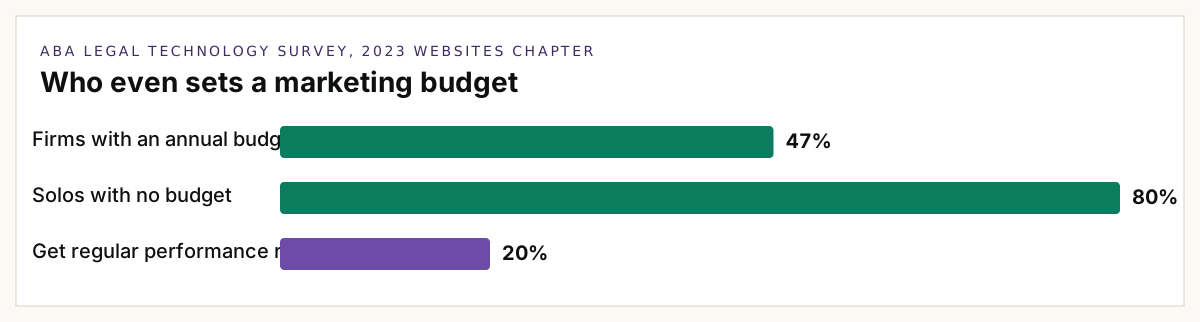
- Only 47% of private-practice respondents in the ABA's 2023 Legal Technology Survey said their firm had an annual marketing budget, down from 57% in 2022 (ABA, Dec 2023).
- 80% of solo practitioners in that ABA survey did not have a marketing budget (ABA, Dec 2023).
- Only about 20% of those respondents receive regular marketing-performance reports from internal or external marketers (ABA, Dec 2023).
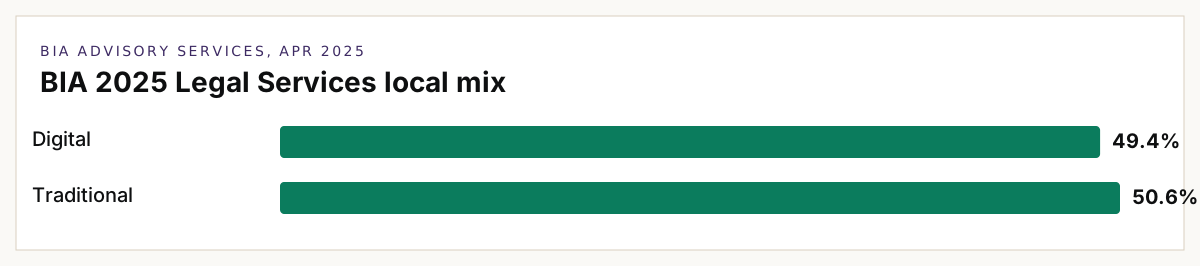
- BIA's 2025 Legal Services local mix is about 49.4% digital and 50.6% traditional. That is a local-media wallet, not owner-led firm mix (BIA Advisory Services, Apr 2025).
- BIA forecasts Legal Services local advertising at about $8.63 billion in 2025, up 4.1% from 2024 (BIA Advisory Services, Apr 2025).
- 92.4% of legal consumers in Martindale-Avvo's 2024 survey research their legal issue online before contacting an attorney. The sample is directory-network users, not a U.S. census (Martindale-Avvo, Dec 2024).
- 61% of those consumers who received a recommendation still researched the attorney online to verify it (Martindale-Avvo, Dec 2024).
- Almost 70% of those consumers named reviews the most helpful element when looking for an attorney (Martindale-Avvo, Dec 2024).
- 81% of firms in CallRail's October 2025 survey say slow responses to inbound calls, texts, or webforms have cost them business (CallRail, Jan 2026).
- Only 57% of those firms expect to increase marketing budgets in 2026, down from 86% who expected an increase the prior year (CallRail, Jan 2026).
- Only 22% of those firms use fundamental tools like call tracking and recording (CallRail, Jan 2026).
- BIA's selling-strategy callout is a twin, not a correction of Martindale: 82% of legal consumers look at online reviews and 81% seek referrals (BIA Advisory Services, Apr 2025).
How much do firms spend on marketing, and do they budget at all?
A marketing line item is not a marketing system. Clio's expense shares describe what firms spend. The ABA survey describes whether they even set a budget. Those are different questions. Do not blend them into a revenue-percent rule of thumb.
What share of firm expenses goes to marketing in Clio's Legal Trends data?
Marketing is a small slice of the P&L and it is growing. It is still not the largest cost.
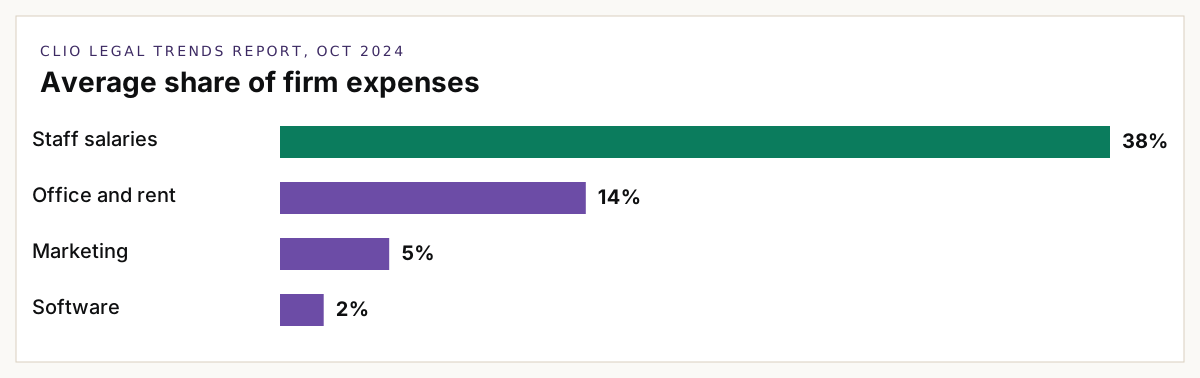
- The average law firm spends roughly 5% of overall expenses on marketing (Clio, Oct 2024).
- That marketing line is growing at a yearly rate of 8% (Clio, Oct 2024).
- Solo lawyers spend nearly twice the industry average on marketing, at 9% (Clio, Oct 2024).
- Solo marketing-spend growth is slower, about 3% per year (Clio, Oct 2024).
- Staff salaries are the largest average expense, at 38% of total costs (Clio, Oct 2024).
- Office expenses and rent together make up a combined 14% of spending (Clio, Oct 2024).
- Firms spend about 2% of expenses on software on average (Clio, Oct 2024).
- Software spend has increased about 21% every year since 2012 (Clio, Oct 2024).
- Revenue growth averaged 9% per year over that same period (Clio, Oct 2024).
- Spending-habit figures draw on historical profit-and-loss reports from 122 solo, small, and medium-sized firms sourced with CPN Legal (Clio, Oct 2024).
- Law firm spending has increased across the board since 2012 and outpaced the average inflation rate of 2.6% over the same period (Clio, Oct 2024).
How do high-productivity firms differ on marketing and software spend?
Clio's productivity cohort is utilization above the industry average. Correlation is not a LawVert guarantee.
- Firms with above-average productivity spend 12% more on software (Clio, Oct 2024).
- Those same firms spend 41% more on marketing (Clio, Oct 2024).
- They earn 21% more in profitability (Clio, Oct 2024).
- The PDF productivity bar is utilization above about 37%, or just under three billable hours per day (Clio, Oct 2024).
- Clio's press summary of the same cohort uses a 33% of workday bar. Quote the PDF or the press. Do not average them (Clio, Oct 2024).
- Solo lawyers spend 0.58% of expenses on software (Clio, Oct 2024).
- Firms with 2 to 4 lawyers spend 1.77% of expenses on software (Clio, Oct 2024).
- Firms with 5 to 19 employees spend 1.37% (Clio, Oct 2024).
- Firms with 20 or more employees spend 1.6% (Clio, Oct 2024).
- Solo software spend is growing at 56% annually, more than twice the industry rate (Clio, Oct 2024).
- Clio also surveyed 1,437 customers from April 15 to 25, 2024, separate from the P&L sample (Clio, Oct 2024).
What share of firms even set an annual marketing budget (ABA Legal Technology Survey)?
Having a budget is a formality question. It is not Clio's expense share. The 2023 TechReport is the origin for budget formality. The 2024 TechReport does not restate that figure in the public article.
- Only 31% of respondents in firms of 2 to 9 lawyers had an annual marketing budget (ABA, Dec 2023).
- 36% of respondents said their marketing budget had increased over the past year (ABA, Dec 2023).
- 58% of respondents say attorneys perform marketing activities in their firms (ABA, Dec 2023).
- Internal marketing staff is involved in 32% of respondents' firms, including over 92% of respondents from firms of 100 or more lawyers (ABA, Dec 2023).
- External consultants are used by 18% of respondents' firms (ABA, Dec 2023).
- 19% report that administrative staff handles marketing activities (ABA, Dec 2023).
- Survey respondents were 22% from solo firms and 30% at firms of 2 to 9 attorneys (ABA, Dec 2023).
- Another 21% were at firms of 10 to 49 attorneys, 6% at 50 to 99, 11% at 100 to 499, and 10% at 500 or more (ABA, Dec 2023).
- Compared with the prior year, 49% said their firm's emphasis on marketing will remain the same (ABA, Dec 2023).
- 28% said marketing is more important for their firm in the coming year, and 6% said it would be less important (ABA, Dec 2023).
- On a 1 to 5 scale, respondents overall scored the effectiveness of their firm's marketing at 3 (ABA, Dec 2023).
- Lawyers in firms with 500 or more lawyers scored marketing effectiveness at 3.5 (ABA, Dec 2023).
- Only 9% of respondents said they were very confident, and 15% said they were not at all confident (ABA, Dec 2023).
- 43% of respondents' firms do not use an external agency, and 47% do not have an internal marketing team (ABA, Dec 2023).
- In CallRail's later vendor survey, only 11% of firms plan to decrease marketing budgets in 2026 (CallRail, Jan 2026).
- The remainder of that CallRail budget chart sits at stay-the-same: 32% (CallRail, Jan 2026).
Where does legal marketing money go, and how do clients actually find firms?
BIA is forecasting a Legal Services local-advertising wallet across offices of lawyers. Martindale-Avvo is surveying consumers who already used Avvo, Lawyers.com, Nolo, or Martindale. Keep the labels. Neither number is PI-only.
What share of Legal Services local ad spend is digital vs traditional (BIA)?
Digital is catching traditional. It has not replaced it in the 2025 mix BIA published. Digital is forecast to pass traditional in 2026.
- 2028 local spend is forecast at $8.83 billion, a 1.6% CAGR from 2024 (BIA Advisory Services, Apr 2025).
- 2024 Legal Services local spend is $8.292 billion in the channel table (BIA Advisory Services, Apr 2025).
- 2023 is charted at about $8.27 billion (BIA Advisory Services, Apr 2025).
- 2022 is about $7.81 billion (BIA Advisory Services, Apr 2025).
- 2021 is about $7.48 billion (BIA Advisory Services, Apr 2025).
- 2020 is about $5.88 billion (BIA Advisory Services, Apr 2025).
- 2019 is about $6.97 billion (BIA Advisory Services, Apr 2025).
- 2026 is forecast at about $8.65 billion (BIA Advisory Services, Apr 2025).
- 2027 is forecast at about $8.81 billion (BIA Advisory Services, Apr 2025).
- Digital channels are forecast to grow at a 4.4% CAGR from 2024 through 2028 (BIA Advisory Services, Apr 2025).
- Traditional Legal Services advertising is forecast to decline at a 1.2% CAGR over the same period (BIA Advisory Services, Apr 2025).
- Digital advertising spending is set to rise by $319 million in 2025, versus $18 million for traditional (BIA Advisory Services, Apr 2025).
- Traditional advertising growth is only 0.4% in 2025 (BIA Advisory Services, Apr 2025).
- BIA ranks Legal Services as the fourth-largest expenditure increase among 96 monitored verticals in 2025 (BIA Advisory Services, Apr 2025).
- Legal Services will expand advertising on 12 of 16 measured media channels in 2025 (BIA Advisory Services, Apr 2025).
- Figures come from BIA's 2025 U.S. Local Advertising Forecast issued March 2025, with numbers rounded (BIA Advisory Services, Apr 2025).
Which media channels lead Legal Services local spend (mobile, mail, TV, search)?
Mobile is BIA's top billing channel. Search is the largest slice of the online pie. Mail and TV still take real dollars. Use this as a wallet map, not a LawVert channel recommendation.
- Mobile is about 23.3% of the 2025 mix and is projected as the top billing channel after passing direct mail in 2023, up 7.3% year over year (BIA Advisory Services, Apr 2025).
- Mobile spend is forecast at about $2.015 billion in 2025, up from $1.878 billion in 2024 (BIA Advisory Services, Apr 2025).
- Direct mail is about 19.1% of the 2025 mix, or about $1.646 billion (BIA Advisory Services, Apr 2025).
- Television (OTA plus digital, in BIA's mix label) is about 17.8% (BIA Advisory Services, Apr 2025).
- TV OTA is forecast at about $1.339 billion in 2025, up 2.2% (BIA Advisory Services, Apr 2025).
- PC/laptop is about 10.2% of mix, or about $884 million in 2025, up 12.7% (BIA Advisory Services, Apr 2025).
- CTV/OTT is about 3.7% of mix, or about $316 million in 2025, up 13.1% (BIA Advisory Services, Apr 2025).
- Of online Legal Services spend, search is about 34.6% (BIA Advisory Services, Apr 2025).
- Online Legal Services ad spend is forecast at about $4.1 billion in 2025, up 8.11% year over year (BIA Advisory Services, Apr 2025).
- Online video display is about 24.9% of that online mix (BIA Advisory Services, Apr 2025).
- Classifieds and verticals are about 22.8%, and other display about 17.8% (BIA Advisory Services, Apr 2025).
- Local social ad spend is forecast at about $793 million in 2025, from $705 million in 2024, up 12.5% (BIA Advisory Services, Apr 2025).
- Digital video advertising for Legal Services is forecast to increase 24.3% year over year (BIA Advisory Services, Apr 2025).
- Cable TV is forecast down 3.2% to about $263 million, and print magazines down 8.0% to about $27.6 million (BIA Advisory Services, Apr 2025).
- Email spend is forecast at about $136 million in 2025, up 7.6% (BIA Advisory Services, Apr 2025).
- Out-of-home is forecast at about $431 million, up 3.8% (BIA Advisory Services, Apr 2025).
How often do consumers research online before contact, even after a referral (Martindale-Avvo)?
A referral is not a close. Directory-network consumers still check. This is not a census of all U.S. legal consumers.
- Almost half (40%) of those consumers rely on recommendations from family, friends, or other lawyers (Martindale-Avvo, Dec 2024).
- The 2024 survey reached 2,357 consumers who had used Martindale-Avvo network sites (Martindale-Avvo, Dec 2024).
- 85% of those consumers expect a response within 48 hours or less (Martindale-Avvo, Dec 2024).
- 40% will wait less than 24 hours before contacting another attorney (Martindale-Avvo, Dec 2024).
- Potential clients commonly contact multiple firms, typically two to three, before settling on one (Martindale-Avvo, Dec 2024).
- The 2026 companion page flags responsiveness as a top hiring criterion for 47.6% of consumers (Martindale-Avvo, Jan 2026).
- Among people with a current or recent legal issue, 37.0% decide to hire a lawyer (Martindale-Avvo, Dec 2024).
- Another 16.7% opt to represent themselves, and 8.4% use online forms or tools (Martindale-Avvo, Dec 2024).
- When focusing only on people with a legal issue in the last 12 months who gave a concrete answer, the hire rate rises to 47.1% (Martindale-Avvo, Dec 2024).
- 86.9% prefer getting information from lawyers rather than non-lawyers when researching a legal issue (Martindale-Avvo, Dec 2024).
- 93.3% say that if they found an attorney through a search engine, they would want to do further research before hiring (Martindale-Avvo, Dec 2024).
- Other hiring considerations included pricing and fees (61.6%), responsiveness (58.0%), and reputation (53.0%) (Martindale-Avvo, Dec 2024).
- Slow response topped the deterrent list, named by 55.2% of those consumers (Martindale-Avvo, Dec 2024).
- Negative reviews online (45.3%) and being too expensive (44.8%) rounded out that top three (Martindale-Avvo, Dec 2024).
- Nearly half (44%) said they would wait 24 to 48 hours for a response before contacting someone else (Martindale-Avvo, Dec 2024).
- Another 20.7% would wait only 1 to 8 hours, and 20.2% would wait 9 to 23 hours (Martindale-Avvo, Dec 2024).
- The most common number of attorneys contacted was three (22.7%), followed by two (18.3%) (Martindale-Avvo, Dec 2024).
- Among consumers who got a recommendation, 54.6% looked at the attorney's website (Martindale-Avvo, Dec 2024).
- The most popular research motives were finding out if the issue is worth pursuing (55.8%) and learning more about rights (55.5%) (Martindale-Avvo, Dec 2024).
- Before reaching out, a majority wanted reviews (63.6%), types of cases accepted (60.8%), and hourly rate or contingency fee (58.7%) (Martindale-Avvo, Dec 2024).
Organic search behavior, zero-click, and Core Web Vitals tables are not this hub. They belong on law firm SEO. PI-owner organic lives on personal injury marketing.
Why do websites and intake still break the marketing system?
Spend that cannot convert is not a channel problem. Clio's secret shop is behavioral and all-practice. CallRail's loss figures are self-reported from a vendor survey with a mid/large-firm skew. Quote both. Do not treat either as PI-only.
How many firm sites give clear hiring-process guidance or pricing (Clio)?
The site is often used as a brochure. Shoppers still cannot find how to hire.
- Just 30% of law firm websites provide clear guidance on the hiring process (Clio, Oct 2024).
- 14% display pricing information (Clio, Oct 2024).
- 74% of surveyed lawyers use the firm website to promote or market services (Clio, Oct 2024).
- 86% of prospective clients said it was easy to find the types of cases a firm handles on the website (Clio, Oct 2024).
- In the ABA 2023 survey, 87% of respondents reported that their firms have a website, down from 94% in 2021 and 2022 (ABA, Dec 2023).
- 65% of solo respondents in that 2023 survey have a website, versus 89% in firms of 2 to 9 lawyers (ABA, Dec 2023).
- The ABA 2024 TechReport updates website incidence to 90% of respondents, with solos at 70% (up from 61% in 2022) and 100% of firms with 100 or more attorneys (ABA, Dec 2024).
- 74% of 2023 ABA respondents say their firm's website is mobile friendly, while 20% do not know (ABA, Dec 2023).
- Only 44% said their law firm website used SSL, and 48% did not know (ABA, Dec 2023).
- 81% of 2023 respondents' firms do not offer live chat; only 12% were sure the site did (ABA, Dec 2023).
- Only 15% said the firm's website offered the ability to schedule an initial consultation (ABA, Dec 2023).
- Only 5% said the website offered fillable forms for document creation (ABA, Dec 2023).
- 96% of firm websites included partner profiles, and 74% included associate profiles (ABA, Dec 2023).
- The most common information collected on sites: names (90%), telephone numbers (73%), and email addresses (42%) (ABA, Dec 2023).
How often do secret-shopped firms answer the phone or email?
Clio hired a third-party shop. This is all-practice, not a PI mystery shop.
- Clio contacted a random sample of 500 U.S. firms from June 20 to July 5, 2024 via email, phone, chatbot, and intake form (Clio, Oct 2024).
- Only 40% of those firms answered the first phone call, down from 56% in 2019 (Clio, Oct 2024).
- Including callbacks, only 52% were reachable by phone, so 48% were unreachable (Clio, Oct 2024).
- 67% of firms emailed in 2024 did not respond, versus 60% non-response in 2019 (Clio, Oct 2024).
- Clio's press summary of the same email shop: only 33% responded (Clio, Oct 2024).
- Of firms that did respond to 2024 emails, all responded within two business days, and 84% within eight hours (Clio, Oct 2024).
- The 2019 email secret shop covered 1,000 U.S. firms (Clio, Oct 2024).
- Voicemail response fell from 43% of firms in 2019 to 20% in 2024 (Clio, Oct 2024).
- 30% of 2024 firms that called back did not leave a voicemail (Clio, Oct 2024).
- Only 12% of shoppers were likely to recommend the firms they contacted (Clio, Oct 2024).
- Shoppers who reached a firm by phone had promotion scores more than three times the average across all channels (Clio, Oct 2024).
- Only 2% of 2024 firms referenced similar legal situations or case law the shoppers asked about, down from 27% in 2019 (Clio, Oct 2024).
- Press: just 18% of email responders provided clear next steps or cost information (Clio, Oct 2024).
- Press: on the phone, 41% offered rate information, 12% provided cost estimates, and 36% explained the legal process or next steps (Clio, Oct 2024).
- Only 7% of law firms use chatbots on their website (Clio, Oct 2024).
- Clio also surveyed 1,003 U.S. adults from June 28 to July 2, 2024 on attitudes toward hiring lawyers (Clio, Oct 2024).
How many firms say slow responses have cost them cases (CallRail)?
CallRail sells tracking and intake tools. Attribute the vendor survey. n=100 with a large-firm skew.
- 35% of those firms say they have lost significant business, estimated at 11 to 25% of revenue (CallRail, Jan 2026).
- The survey covered 100 U.S. legal professionals in October 2025, at 95% confidence with a plus-or-minus 5% margin of error (CallRail, Jan 2026).
- Firm-size mix: 4% with 1 to 19 people, 19% with 20 to 99, 37% with 100 to 249, and 40% with 250 to 499 (CallRail, Jan 2026).
- Roles: executive leadership 43%, marketing 25%, and operations 22% (CallRail, Jan 2026).
- Phone and email were each cited by 69% as first-contact channels, and 36% cited text (CallRail, Jan 2026).
- For ongoing communications, firms report clients rely on phone (calling or texting) 69% of the time, while email drops to 20% (CallRail, Jan 2026).
- 84% of clients who initially reach out by phone prefer to stay on the phone for ongoing communications (CallRail, Jan 2026).
- 91% of clients who reach out by text first prefer to continue over text (CallRail, Jan 2026).
- 68% of firms rely on lawyers and paralegals to handle most of the client intake process (CallRail, Jan 2026).
- Firms with dedicated intake staff were less likely to report lost business due to missed calls (34% compared with 52% overall) (CallRail, Jan 2026).
- Barely half (51%) have a CRM or client management system, and only 11% use a virtual receptionist (CallRail, Jan 2026).
- Inside the firm, leading operations challenges include sales and customer-service training (59%), lead follow-up and conversion (50%), and appointment scheduling (46%) (CallRail, Jan 2026).
- Growing firms (those seeing a 20% revenue increase over the last few years) are twice as likely to consider client experience when adopting new tech compared with shrinking firms (CallRail, Jan 2026).
If the phone is the product and it is not answered, raising budget scales the miss. Book a 15-minute strategy call to look at the handoff, not just the channel mix.
What does paid attention cost, and how big is the legal ad wallet?
This section is a tease. Blended legal CPC is not a PI head-term quote. ATRA's Vivvix ads and BIA's local wallet are different scopes. Depth lives on the PI advertising statistics hub.
What is the WordStream median CPC / CPL for Attorneys and Legal Services?
Highest in the 2026 industry table. Still a category median. An in-platform lead is not a signed case.
- Attorneys and Legal Services had the highest industry median CPC at $9.87 (WordStream, May 2026).
- The same blended legal category posted the highest industry median cost per lead at $131.63 (WordStream, May 2026).
- Cross-industry averages in that study were CPC $5.42 and CPL $66.69 (WordStream, May 2026).
- The 2026 sample is 13,474 U.S. search campaigns running April 1, 2025 through March 31, 2026 (WordStream, May 2026).
- Legal's 2026 click-through rate was 5.87%, below the 6.64% cross-industry average (WordStream, May 2026).
- The next-highest 2026 CPCs after legal were Home and Home Improvement at $8.33 and Dentists and Dental Services at $8.00 (WordStream, May 2026).
Metro auction tables, YoY legal CPC series, and PI caveats are not duplicated here. Read personal injury lawyer advertising statistics. Firm-wide PPC process lives on Google Ads for law firms.
What do ATRA and BIA put on the U.S. legal-services ad wallet?
Two research shops. Two wallets. Do not average them into "the" legal marketing spend. ATRA is a tort-reform advocacy group using Vivvix estimates.
- In 2024, ATRA estimates more than $2.5 billion was spent on more than 26.9 million ads for legal services or soliciting legal claims across the United States (ATRA, Mar 2025).
- From 2020 to 2024, spending on those ads rose about 39% while ad quantity fell about 4% (ATRA, Mar 2025).
- Digital spend rose 84% while digital ad quantity fell more than 50% (ATRA, Mar 2025).
- Television ad quantity peaked in 2023 at more than 16.4 million legal-services TV ads, about 44% above 2017 (ATRA, Mar 2025).
- Radio ad quantity peaked in 2024 at more than 6.8 million ads, up more than 261% from 1.8 million in 2017 (ATRA, Mar 2025).
BIA's Legal Services local forecast is the broader wallet already attributed above. Channel and PI-ad depth stay on the ads statistics hub. This page does not retarget personal injury lawyer advertising.
How widely do firms use content, email, and social as marketing channels?
Incidence of having a blog is not performance. The ABA survey measures what firms report they have. CallRail measures what a vendor-surveyed set implemented or plans next.
What share of firms have a website, blog, or email marketing program (ABA)?
Having the channel is the floor. The ABA does not publish a success rate for LinkedIn posts.
- One third of 2023 respondents say their law firms have a blog (ABA, Dec 2023).
- Email marketing is embraced by about 32% of respondents' firms (ABA, Dec 2023).
- Only 12% of respondents maintain their own legal-topic blogs (ABA, Dec 2023).
- Of firms that market via email, 66% send client alerts, 41% send newsletters, and 35% send individual personalized email (ABA, Dec 2023).
- Only 35% reported having a client retain them directly through the firm website, up from 25% in 2022 (ABA, Dec 2023).
- 29% of those whose firms have blogs report clients retained the firm from the blog, including 45% of solos (ABA, Dec 2023).
- Outside-agency hire mix includes website design 42%, SEO 28%, social media 27%, and AdWords/PPC only 8% (ABA, Dec 2023).
- Print marketing 9%, online leads 9%, directory listings 6%, and direct mail, TV ads, or online promotions 3% each (ABA, Dec 2023).
- 30% of respondents said their firms produce video to market the practice, and only 4% produce video themselves (ABA, Dec 2023).
- Those videos are most often housed on the firm's website (63%), followed by YouTube (46%) (ABA, Dec 2023).
- Other channels: sponsoring or attending events 35%, print marketing 16%, and direct mail campaigns 12% (ABA, Dec 2023).
- 32% of respondents said that one lawyer in their firm has access to the firm's web analytics (ABA, Dec 2023).
How common is social presence, and which networks lead (ABA)?
Social incidence fell in the 2024 TechReport. Confidence still splits by firm size.
- Only 16% of 2023 respondents said their firms had no online or social presence (ABA, Dec 2023).
- Of firms with social presence in 2023, LinkedIn was 83%, Facebook 57%, and Twitter/X 33% (ABA, Dec 2023).
- 81% of 2023 respondents participate on social media themselves for professional purposes (ABA, Dec 2023).
- Of those personal professional accounts: LinkedIn 87%, Facebook 40%, Twitter/X 25%, and Instagram 18% (ABA, Dec 2023).
- The 2024 TechReport finds social media as a marketing tool declined to 80%, from 89% in 2022 (ABA, Dec 2024).
- 2024 network mix: LinkedIn 76% and Facebook 53% (ABA, Dec 2024).
- Marketing-confidence scores in 2024: larger firms about 3.3 out of 5 versus solos and small firms about 2.7 out of 5 (ABA, Dec 2024).
- Of respondents who use social media themselves for professional purposes, 31% report a client retained them through that use (ABA, Dec 2023).
- Less than 46% of respondents report that their firms have policies on social-network participation, and 27% have policies for blogging (ABA, Dec 2023).
- Personal professional motives in 2023: career development 70%, community engagement 51%, education 48%, and client development 47% (ABA, Dec 2023).
Which newer channels are firms implementing or planning next (CallRail)?
Self-reported implementation intent is not spend share. It is channel sprawl: many tactics, one intake path.
- In the past year, surveyed firms implemented paid social (59%), email (50%), and video (50%) among new channels (CallRail, Jan 2026).
- SEO was cited at 48% in that implemented-in-2025 chart, and another channel band (GEO/AEO) at 41% (CallRail, Jan 2026).
- For 2026 plans, at least one in three firms plan to add SMS/text (39%), organic social (36%), and video (33%) (CallRail, Jan 2026).
- Those plans are followed by influencer (29%) and email (28%) (CallRail, Jan 2026).
- For firms planning budget increases, the largest investment areas are email (51%), influencer marketing (49%), and paid social (47%) (CallRail, Jan 2026).
- Trade shows (25%) and traditional advertising (12%) will see the least increase (CallRail, Jan 2026).
- Asked which trends will define legal marketing in 2026, firms pointed to short-form video (62%), automation (50%), and personalization (47%) (CallRail, Jan 2026).
- Digital channels driving new business: SEO (54%), paid search (50%), video (47%), paid social (38%), and content (37%) (CallRail, Jan 2026).
- Larger firms report paid search as a critical new-business channel at 63%, compared with 53% overall (CallRail, Jan 2026).
- A combined 89% of firms are moderately (51%) or extremely (38%) confident they know how to use marketing to find their best clients (CallRail, Jan 2026).
- The most common 2026 challenges include keeping up with technology (51%), increased competition (50%), and declining demand (48%) (CallRail, Jan 2026).
What outcomes look like when marketing reaches intake?
Lift in a product cohort is not a universal ROI claim. Public proof on LawVert is one firm. Search Console is a measurement floor, not a success definition.
What lead and revenue lift shows up when firms use client-facing online intake capabilities (Clio)?
Clio measured Clio Grow capabilities. Attribute the cohort.
- Firms using studied client-facing capabilities saw 51% more client leads than firms not using those capabilities (Clio, Oct 2024).
- Those same firms showed 52% higher revenues. Press often rounds this pair to 50% / 50%. Prefer the PDF (Clio, Oct 2024).
- A 2020 Clio analysis found firms using dedicated client intake software saw as much as 20% more cases and earned 26% more revenue than firms not using the software (Clio, Oct 2024).
- The 2024 client-facing capabilities tied to that lift include online schedulers, online search ads, and online intake forms (Clio, Oct 2024).
- E-signatures, shared intake forms, and text messaging had modest correlations with higher conversion rates in that chapter (Clio, Oct 2024).
- Online search ads and e-signatures were associated with quicker time-to-hire (Clio, Oct 2024).
- Google Search Console performance reports cover impressions, clicks, and pages. That is a measurement floor, not a LawVert benchmark (Google Search Console Help, Sep 2026).
What public Search Console and SEO-attributed signed figures does LawVert publish for Conduit Law?
Proof card only. Historical one-firm results. Not a promise of future clicks, leads, or signed cases. No second firm. No invented ROAS.
- Property `sc-domain:conduit.law`, web search, Oct 13, 2025 through Aug 21, 2026: 7.61K Google clicks (LawVert, Sep 2026).
- The same window: 2.0M impressions, 0.4% CTR, average position 23.9 (LawVert, Sep 2026).
- Monthly clicks rose 9.2 times from December 2025 (224) to July 2026 (2,060) (LawVert, Sep 2026).
- Trailing year ending 2026-08-25: 162 organic-search leads and 66 SEO-attributed signed cases (LawVert, Sep 2026).
- Stack on conduit.law: 668+ indexed pages, 508 location pages, 25 practice areas, and 91 blog posts (LawVert, Sep 2026).
Those figures live on the Conduit Law case study and move with the property. Book a 15-minute strategy call if you want the same wiring looked at against a live site. The commercial definition of the program stays on law firm marketing.
Methodology and Sources
Every number on this page traces to the organization that produced it: Clio's Legal Trends Report, the ABA Legal Technology Survey TechReports, BIA's Legal Services local-advertising forecast, Martindale-Avvo consumer surveys, CallRail's 2026 marketing outlook, WordStream/LocaliQ search medians, ATRA/Vivvix legal-ad estimates, Google Search Console Help, and LawVert's public Conduit Law case study. Roundups, competitor statistics hubs, and agency CPC bands are not sources. BIA is a Legal Services local wallet, not owner-led mix. ATRA is advocacy estimates of legal-services and lawsuit-solicitation ads. Martindale-Avvo is a directory-network sample. CallRail is a vendor survey (n=100, mid/large skew). ABA budget formality is a survey share, not spend-of-revenue. Clio intake lift is a studied-capabilities cohort. WordStream is a blended legal median, not a PI head-term auction. Lead is not signed case. Cross-practice stats are not PI-only. This page is refreshed monthly. Accessed September 9, 2026.
Article Sources
- Clio 2024 Legal Trends Report (PDF) Accessed September 9, 2026. ↩
- Clio, latest Legal Trends Report press summary Accessed September 9, 2026. ↩
- ABA, 2023 Websites and Marketing TechReport Accessed September 9, 2026. ↩
- ABA, 2024 Websites and Marketing TechReport Accessed September 9, 2026. ↩
- BIA Advisory Services, 2025 Legal Vertical Report (PDF) Accessed September 9, 2026. ↩
- Martindale-Avvo, Understanding the Legal Consumer Report 2024 (PDF) Accessed September 9, 2026. ↩
- Martindale-Avvo, The State of the Legal Consumer Report 2026 Accessed September 9, 2026. ↩
- CallRail, The 2026 marketing outlook for law firms (PDF) Accessed September 9, 2026. ↩
- WordStream, Google Ads Benchmarks 2026 Accessed September 9, 2026. ↩
- ATRA, Legal Services Advertising in the United States 2020-2024 Accessed September 9, 2026. ↩
- LawVert, Conduit Law case study Accessed September 9, 2026. ↩
- Google Search Console Help, How are you performing on Google? Accessed September 9, 2026. ↩
Glossary
- ABA TechReport: Public article summarizing the ABA Legal Technology Survey. Survey of private-practice attorneys, not a revenue-percent census.
- BIA: BIA Advisory Services. Legal Services here is a local-media wallet across many channels and practice types.
- ATRA: American Tort Reform Association. Vivvix-based estimates of ads for legal services or soliciting legal claims. Advocacy source.
- Martindale-Avvo network sample: Consumers who had used Avvo, Lawyers.com, Nolo, or Martindale. Not all U.S. legal consumers.
- CallRail outlook: Vendor survey of 100 U.S. firms (October 2025). Self-reported loss and channel plans. Mid/large-firm skew.
- LTR: Clio Legal Trends Report.
- CPC: Cost per click. What the advertiser pays for a search-ad click.
- CPL: Cost per lead. In-platform cost of a tracked conversion. Not cost per signed case.
- PPC: Pay-per-click advertising.
- SEO: Search engine optimization. Depth on this topic lives on the law firm SEO hub, not here.
- GSC: Google Search Console. Impressions, clicks, and pages are a measurement floor.
- GEO/AEO: Generative / answer-engine optimization labels used in some vendor charts. Not a FirmOps product claim on this page.
- Intake: The path from first contact to opened matter.
- Primary source: The organization that originally produced the data.
- Aggregator: A page that republishes other people's stats without producing the data.
Related LawVert reading
After website and intake
Marketing spend still fails at the phone
If the report stops at channel mix, the missing number is the opened matter. Public proof is only the Conduit Law case study. We do not publish a universal ROAS.
Book a callNext step
Bring the channels and the intake path
Book a 15-minute strategy call. The stats describe the gap. The call is whether LawVert under Cadence MSO is a fit. No ranking promise. No invented case results.
Book a callPrefer to email first? hello@lawvert.com · Send a note