Personal injury lawyer advertising statistics
140 Personal Injury Lawyer Advertising Statistics 2026
Primary sources only. ATRA and BIA are different wallets. A WordStream lead is not a signed case.
Updated SEPTEMBER 2026
Written by Jonathan Mahler, reviewed by Jonathan Mahler. Operator notes, not legal advice.
Two research shops publish legal advertising dollars, and they are not measuring the same wallet. Treat every headline spend figure as a definition, not a census. ATRA's Vivvix-based estimates cover legal-services and lawsuit-solicitation ads. BIA's Legal Services forecast is a broader local-media wallet. This page keeps those figures attributed and never blends them into one "the" number.
Paid search medians from WordStream describe Attorneys and Legal Services as a blended category. They are not personal-injury head-term auction prices, and an in-platform lead is not a signed case. The commercial how-to lives on personal injury lawyer advertising. This URL is the citation ledger. Updated September 2026.
Key Takeaways
- ATRA estimates more than $2.5 billion was spent on more than 26.9 million U.S. legal-services or lawsuit-solicitation ads in 2024 (ATRA, Mar 2025).
- BIA forecasts Legal Services local advertising at about $8.63 billion in 2025, up 4.1% from 2024. That is a different scope from ATRA, not a correction of it (BIA Advisory Services, Apr 2025).
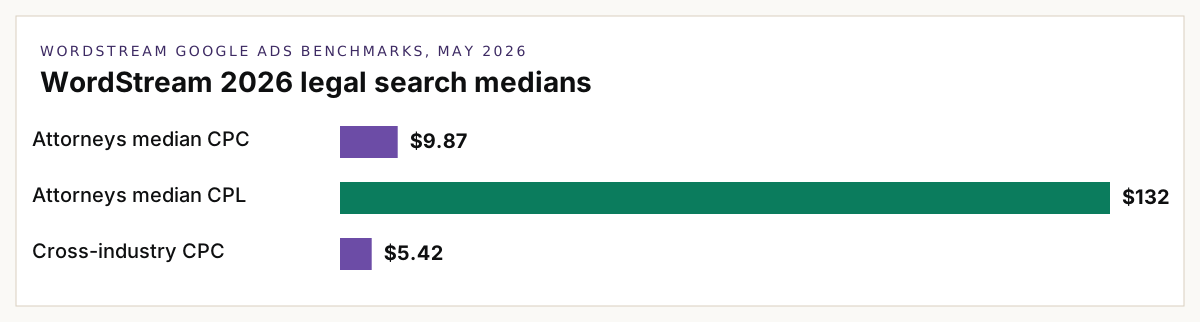
- Attorneys and Legal Services posted the highest industry median Google Ads CPC at $9.87 in WordStream's 2026 benchmarks (WordStream, May 2026).
- The same blended legal category posted the highest industry median cost per lead at $131.63. That is an in-platform lead cost, not cost per signed case (WordStream, May 2026).
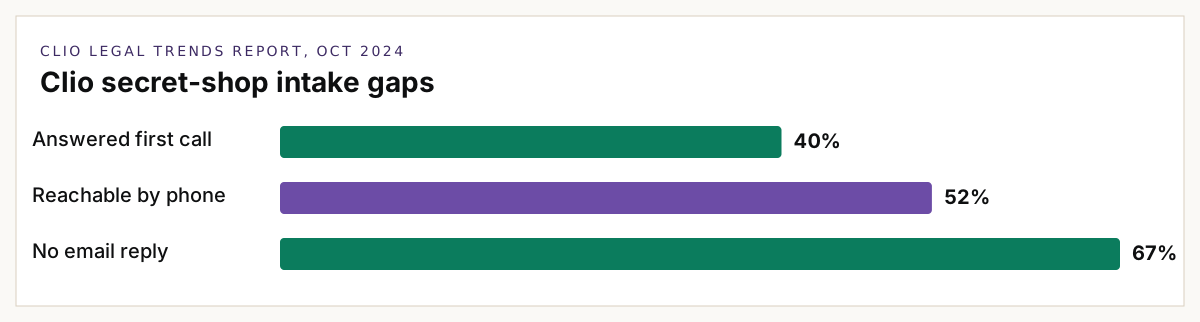
- Only 40% of firms in Clio's 2024 secret shop answered the first phone call, down from 56% in 2019 (Clio, Oct 2024).
- 67% of firms emailed in that secret shop did not respond at all, versus 60% non-response in 2019 (Clio, Oct 2024).
- Including callbacks, only 52% of firms were reachable by phone, so 48% were unreachable (Clio, Oct 2024).
- Firms with above-average productivity spend 41% more on marketing and earn 21% more in profitability (Clio, Oct 2024).
- Firms using studied client-facing intake capabilities saw 51% more client leads and 52% higher revenues than firms not using those capabilities. That is Clio research on a product cohort, not a universal guarantee (Clio, Oct 2024).
- BIA's 2025 Legal Services mix is about 49.4% digital and 50.6% traditional, with digital forecast to pass traditional in 2026 (BIA Advisory Services, Apr 2025).
- ATRA reports legal digital ad spend rose 84% from 2020 to 2024 while digital ad quantity fell more than 50% (ATRA, Mar 2025).
- ABA Model Rule 7.2 lets a lawyer communicate information about services through any media, and requires the name and contact information of at least one lawyer or firm responsible for the content. That is a model rule, not legal advice (ABA, Aug 2018).
How much do U.S. legal advertisers spend?
The honest answer starts with whose spreadsheet you opened. ATRA is a tort-reform advocacy group using Vivvix estimates. BIA is a local-advertising forecast shop covering the full Legal Services vertical. Quote both. Do not average them.
What is the Vivvix / ATRA estimate for legal-services ad spend and volume in a recent year?
ATRA's nationwide series is an estimate of ads for legal services or soliciting legal claims, not a PI-only census and not a regulator count.
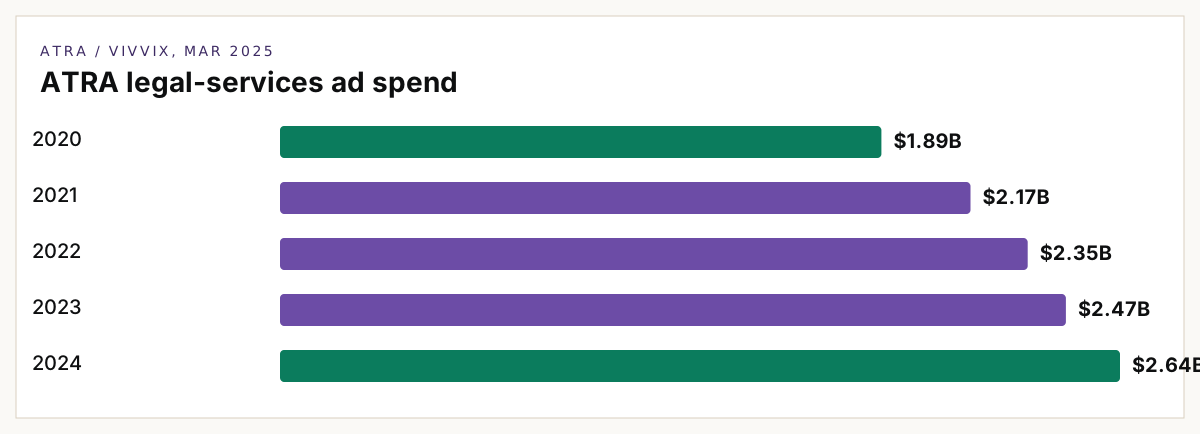
- ATRA's charted 2024 total is about $2.64 billion across 26.98 million ads (ATRA, Mar 2025).
- From 2020 to 2024, ATRA estimates spending on those ads rose about 39% while ad quantity fell about 4% (ATRA, Mar 2025).
- Pizza restaurants, used as ATRA's scale comparison, spent $1.1 billion on 4.1 million ads in the same 2024 window (ATRA, Mar 2025).
- 2023 legal-services ad spend in the Vivvix series was about $2.47 billion (ATRA, Mar 2025).
- 2022 spend was about $2.35 billion (ATRA, Mar 2025).
- 2021 spend was about $2.17 billion (ATRA, Mar 2025).
- 2020 spend was about $1.89 billion, on 28.15 million ads, the quantity peak in the published series (ATRA, Mar 2025).
- 2023 ad quantity was about 26.40 million (ATRA, Mar 2025).
- Morgan & Morgan spent an estimated $218.2 million in 2024 and accounted for 8% of legal-services ad dollars in ATRA's ranking, with about 2.47 million ad units (ATRA, Mar 2025).
- LegalZoom spent an estimated $59.7 million, mostly small-business legal solutions rather than injury TV (ATRA, Mar 2025).
- Los Defensores spent an estimated $48.7 million (ATRA, Mar 2025).
- Sweet James spent an estimated $44.7 million (ATRA, Mar 2025).
- Thomas J. Henry spent an estimated $38.8 million (ATRA, Mar 2025).
- Los Angeles was ATRA's top 2024 legal-services ad market at about $164.9 million (ATRA, Mar 2025).
- New York City was second at about $100.8 million (ATRA, Mar 2025).
- Atlanta was third at about $88.0 million (ATRA, Mar 2025).
- Orlando spent about $80.3 million and led ATRA's 2024 quantity ranking with about 775,320 ads (ATRA, Mar 2025).
- Television remains ATRA's most-used legal-services medium by dollars and quantity, with an estimated 83% of TV dollars from 2017 to 2024 going to local Spot TV (ATRA, Mar 2025).
- Morgan & Morgan's 2024 Spot TV buy was about $110.7 million and more than 1.57 million units, more than 5-to-1 versus the next Spot TV spender (ATRA, Mar 2025).
- ATRA's Vivvix mediums are out-of-home, print, radio, TV, and digital, and the digital slice excludes social media (ATRA, Mar 2025).
- Analysis was conducted by ATRA using data provided by Vivvix (ATRA, Mar 2025).
How does BIA's broader Legal Services local-ad forecast compare (scope whiplash)?
BIA is forecasting a local advertising wallet for offices of lawyers. That includes channels and advertisers ATRA's Vivvix legal-ads series does not claim to cover. Keep the labels.
- BIA's 2024 Legal Services local spend is about $8.29 billion on the forecast chart and $8.292 billion in the channel table (BIA Advisory Services, Apr 2025).
- 2023 local spend is charted at about $8.27 billion (BIA Advisory Services, Apr 2025).
- 2022 is about $7.81 billion (BIA Advisory Services, Apr 2025).
- 2021 is about $7.48 billion (BIA Advisory Services, Apr 2025).
- 2020 is about $5.88 billion (BIA Advisory Services, Apr 2025).
- 2019 is about $6.97 billion (BIA Advisory Services, Apr 2025).
- 2026 is forecast at about $8.65 billion (BIA Advisory Services, Apr 2025).
- 2027 is forecast at about $8.81 billion (BIA Advisory Services, Apr 2025).
- 2028 local spend is forecast at $8.83 billion, a 1.6% CAGR from 2024 (BIA Advisory Services, Apr 2025).
- BIA ranks Legal Services as the fourth-largest expenditure increase among 96 monitored verticals in 2025 (BIA Advisory Services, Apr 2025).
- Figures come from BIA's 2025 U.S. Local Advertising Forecast issued March 2025, with numbers rounded (BIA Advisory Services, Apr 2025).
Where does legal advertising money go by channel?
Channel mix is where PI partners argue from memory. The primary tables are still legal-services-wide. Use them as a wallet map, then measure your own campaigns.
What share of Legal Services local spend is digital vs traditional in the latest BIA forecast year?
Digital is catching traditional. It has not replaced it in the 2025 mix BIA published.
- Digital channels are forecast to grow at a 4.4% CAGR from 2024 through 2028 (BIA Advisory Services, Apr 2025).
- Traditional Legal Services advertising is forecast to decline at a 1.2% CAGR over the same period (BIA Advisory Services, Apr 2025).
- Digital advertising spending is set to rise by $319 million in 2025, versus $18 million for traditional (BIA Advisory Services, Apr 2025).
- Traditional advertising growth is only 0.4% in 2025, while TV OTA is forecast up 2.2% (BIA Advisory Services, Apr 2025).
- Online Legal Services ad spend is forecast to grow 8.11% from 2024 to 2025, to about $4.1 billion (BIA Advisory Services, Apr 2025).
- Legal Services will expand advertising on 12 of 16 measured media channels in 2025 (BIA Advisory Services, Apr 2025).
Which channels lead Legal Services local spend (mobile, search, social, TV)?
Mobile is BIA's top billing channel. Search is the largest slice of the online pie. TV and mail still take real dollars.
- Mobile is about 23.3% of the 2025 Legal Services mix and is projected as the top billing channel after passing direct mail in 2023, up 7.3% year over year (BIA Advisory Services, Apr 2025).
- Mobile spend is forecast at about $2.015 billion in 2025, up from $1.878 billion in 2024 (BIA Advisory Services, Apr 2025).
- Direct mail is about 19.1% of the 2025 mix, or about $1.646 billion (BIA Advisory Services, Apr 2025).
- Television (OTA plus digital, in BIA's mix label) is about 17.8% (BIA Advisory Services, Apr 2025).
- TV OTA is forecast at about $1.339 billion in 2025 (BIA Advisory Services, Apr 2025).
- PC/laptop is about 10.2% of mix, or about $884 million in 2025, up 12.7% (BIA Advisory Services, Apr 2025).
- CTV/OTT is about 3.7% of mix, or about $316 million in 2025, up 13.1% (BIA Advisory Services, Apr 2025).
- Of online Legal Services spend, search is about 34.6% (BIA Advisory Services, Apr 2025).
- Online video display is about 24.9% of that online mix (BIA Advisory Services, Apr 2025).
- Classifieds and verticals are about 22.8%, and other display about 17.8% (BIA Advisory Services, Apr 2025).
- Local social ad spend is forecast at about $793 million in 2025, from $705 million in 2024, up 12.5% (BIA Advisory Services, Apr 2025).
- Digital video advertising for Legal Services is forecast to increase 24.3% year over year (BIA Advisory Services, Apr 2025).
- Cable TV is forecast down 3.2% to about $263 million, and print magazines down 8.0% to about $27.6 million (BIA Advisory Services, Apr 2025).
- 82% of legal consumers look at reviews online, and 81% rely on referrals (BIA Advisory Services, Apr 2025).
- ATRA's 2024 digital legal-services spend, excluding social, is about $726 million, up from $394 million in 2020 (ATRA, Mar 2025).
- ATRA's 2024 TV legal-services spend is about $1.03 billion (ATRA, Mar 2025).
- Television ad quantity peaked in 2023 at more than 16.4 million legal-services TV ads, about 44% above 2017 (ATRA, Mar 2025).
- Radio ad quantity peaked in 2024 at more than 6.8 million ads, up more than 261% from 1.8 million in 2017, with radio spend up 134% versus 2017 (ATRA, Mar 2025).
- 2024 radio spend was about $300.5 million (ATRA, Mar 2025).
- Out-of-home legal-services spend rose more than 260% versus 2017, to about $541.6 million in 2024, including an estimated $1.9 million in cinema (ATRA, Mar 2025).
- Print legal-services spend in 2024 was about $41.0 million (ATRA, Mar 2025).
What does paid search cost for attorneys and legal services?
Search is expensive in this category because the auction is crowded, not because a median CPC is a PI head-term quote. Read WordStream as a blended legal median. Then look at your own Keyword Planner export.
What is the WordStream median CPC for Attorneys and Legal Services?
It is the highest industry CPC in the 2026 table. It is still a category median.
- Cross-industry average CPC in that 2026 study is $5.42 (WordStream, May 2026).
- The next-highest 2026 CPCs after legal were Home and Home Improvement at $8.33 and Dentists and Dental Services at $8.00 (WordStream, May 2026).
- In the prior-year 2025 benchmarks, Attorneys and Legal Services CPC was $8.58 (WordStream, May 2025).
- Cross-industry average CPC in 2025 was $5.26 (WordStream, May 2026).
- WordStream's 2026 CPC is more than twice the $2.32 average from its 2016 reports (WordStream, May 2026).
- Legal's 2026 click-through rate was 5.87%, below the 6.64% cross-industry average (WordStream, May 2026).
- Legal CTR in 2025 was 5.97%, against a 6.66% cross-industry average (WordStream, May 2025).
- The 2026 sample is 13,474 U.S. LocaliQ customer search campaigns running April 2025 through March 2026 (LocaliQ, May 2026).
- In aggregate, about 80-85% of that sample budget is allotted to Google and 15-20% to Microsoft (LocaliQ, May 2026).
- The 2025 benchmarks used more than 16,000 U.S. campaigns from April 2024 through March 2025 (WordStream, May 2026).
- Attorneys and Legal Services had an average Quality Score of 5.02 in a separate WordStream grader study, among the lowest industry scores (WordStream, Feb 2026).
- That Quality Score study used 251,236 reports from 15,666 Google Ads accounts between January 1, 2025 and November 17, 2025, and "averages" are medians (LocaliQ, Feb 2026).
What is the WordStream median cost per lead for the same category?
Highest in the table. Still a lead, not a retained client.
- Cross-industry average CPL in 2026 is $66.69 (WordStream, May 2026).
- Furniture ($106.70) and Real Estate ($102.51) were the next-highest 2026 CPLs (WordStream, May 2026).
- 2025 legal CPL was also $131.63, against a $70.11 cross-industry average (WordStream, May 2025).
- Cross-industry CPL in 2016 was $59.18, so the 2026 $66.69 average is about 13% higher over that decade (WordStream, May 2026).
- 2026 is the first year in five that overall average CPL fell (WordStream, May 2026).
- Cross-industry conversion rate in 2026 is 8.18% (WordStream, May 2026).
- Cross-industry conversion rate in 2025 was 7.52% (WordStream, May 2026).
- Attorneys and Legal Services conversion rate in the 2025 WordStream tables was 5.09% (WordStream, Oct 2025).
- Conversion rate increased for 87% of industries in the 2026 report (WordStream, May 2026).
Why PI head-term CPCs are higher than the blended legal median
Because "Attorneys and Legal Services" mixes estate planning, business law, and injury terms into one median. WordStream does not publish a PI-only auction table. Agency listicles that quote $50 to $300 PI CPCs are not origin research, so they are not cited here.
- Google Ads can count calls as conversions when call reporting is on, by duration in the ad account or by importing outcomes from another system (Google Ads Help, Sep 2026).
- Conversion measurement is how Google Ads reports the actions you choose to track, not a signed-retainer feed by default (Google Ads Help, Sep 2026).
- Offline conversion import is how a later signed retainer can be sent back to the click ID. Without that handoff, the report stops at cost per lead (Google Ads Help, Sep 2026).
If the number you care about is signed cases, the bid is not the product. Lawyer advertising and PPC is the process hub. Book a 15-minute strategy call if you want that wiring looked at against a live account. The only public proof card is Conduit Law.
Why do expensive PI ads still fail at the firm?
Because the auction can be working while the phone is not. Clio's secret shop is all-practice, not PI-only. It is still the strongest primary on first-touch failure.
How many firms answer a first phone call from a prospective client?
Fewer than half pick up. Fewer still are reachable even after a callback window.
- Clio hired a third-party shop to contact 500 U.S. law firms from June 20 to July 5, 2024 via email, phone, chatbot, and intake form (Clio, Oct 2024).
- The 2019 study phoned 500 firms and reached 73% when callbacks were included (Clio, Oct 2024).
- Voicemail response fell from 43% of firms in 2019 to 20% in 2024 (Clio, Oct 2024).
- 30% of 2024 firms that called back did not leave a voicemail (Clio, Oct 2024).
- Only 12% of shoppers were likely to recommend the firms they contacted (Clio, Oct 2024).
- Shoppers who reached a firm by phone had the highest promotion scores, more than three times the average across all channels (Clio, Oct 2024).
How many firms respond to a first email inquiry?
Most do not. The ones that do tend to be fast, and still thin on the information a tired caller asked for.
- The 2019 email secret shop covered 1,000 U.S. firms (Clio, Oct 2024).
- Of firms that did respond to 2024 emails, all responded within two business days, and 84% within eight hours (Clio, Oct 2024).
- Only 2% of 2024 firms referenced similar legal situations or case law the shoppers asked about, down from 27% in 2019 (Clio, Oct 2024).
- 74% of surveyed lawyers use the firm website to promote services, but shoppers still struggled to find hiring steps or pricing (Clio, Oct 2024).
- 86% of prospective clients said it was easy to find the types of cases a firm handles on the website (Clio, Oct 2024).
If the phone is the product and it is not answered, raising budget scales the miss. Book a 15-minute strategy call to look at the handoff, not just the bid.
Do firms that invest in marketing and intake outperform?
Clio's spending chapter is about firms that spend more on marketing and software, and firms that use client-facing intake tools. Attribute the cohort. Do not turn it into a LawVert ROI claim.
How much more do above-average-productivity firms spend on marketing?
They spend more, and they show higher utilization and profit in Clio's tables. Productivity here is utilization above the industry average.
- Those above-average-productivity firms also spend 12% more on software (Clio, Oct 2024).
- The productivity bar is utilization above the industry average of about 37%, or just under three billable hours per day (Clio, Oct 2024).
- The average firm spends roughly 5% of overall expenses on marketing, growing about 8% per year (Clio, Oct 2024).
- Solo lawyers spend nearly twice that industry average on marketing, at 9%, but their marketing spend grows only about 3% per year (Clio, Oct 2024).
- Firms spend about 2% of expenses on software on average, and that line has increased about 21% every year since 2012 (Clio, Oct 2024).
- Software spend growth has outpaced revenue growth, which averaged 9% per year over the same period (Clio, Oct 2024).
- Solo lawyers spend 0.58% of expenses on software, while 2-4 lawyer firms spend 1.77% (Clio, Oct 2024).
- Firms with 5-19 employees spend 1.37% of expenses on software, and firms with 20 or more spend 1.6% (Clio, Oct 2024).
- Solo software spend is growing at 56% annually, more than twice the industry rate (Clio, Oct 2024).
- Staff salaries are the largest average expense at 38% of total costs, with office expenses and rent a combined 14% (Clio, Oct 2024).
- Spending-habit figures draw on historical profit-and-loss reports from 122 solo, small, and medium-sized firms sourced with CPN Legal (Clio, Oct 2024).
What lift in leads and revenue shows up when firms use client-facing online intake tools?
Clio measured Clio Grow capabilities: online schedulers, online search ads, online intake forms, and related features. Quote the PDF percentages, not the press rounding.
- A 2020 Clio analysis found firms using dedicated client intake software saw as much as 20% more cases and earned 26% more revenue than firms not using the software (Clio, Oct 2024).
- Online schedulers, online search ads, and online intake forms are the client-facing capabilities tied to the 2024 lead and revenue lift (Clio, Oct 2024).
- E-signatures, shared intake forms, and text messaging had modest correlations with higher conversion rates in that same chapter (Clio, Oct 2024).
- Online search ads and e-signatures were associated with quicker time-to-hire (Clio, Oct 2024).
What advertising rules frame public lawyer ads?
This is a rules frame, not a market size. Model rules are not state law. State bars govern. Nothing here is legal advice.
What does ABA Model Rule 7.2 allow and require for lawyer advertising communications?
It allows advertising. It restricts paying for recommendations. It requires a responsible name and contact path.
- A lawyer shall not compensate, give, or promise anything of value to a person for recommending the lawyer's services except for the listed exceptions (ABA, Aug 2018).
- Those exceptions include paying the reasonable costs of advertisements or communications permitted by the rule (ABA, Aug 2018).
- A lawyer shall not state or imply certification as a specialist unless an approved organization certified the lawyer and the certifying organization is named (ABA, Aug 2018).
- Comment [1] says the rule permits public dissemination of the firm's name, address, email, website, telephone number, kinds of services, and fee basis, among other information (ABA, Aug 2018).
- Comment [3] allows paying for advertising costs including print and online directory listings, newspaper ads, television and radio airtime, domain-name registrations, internet-based advertisements, and group advertising (ABA, Aug 2018).
- Comment [5] allows paying others for generating client leads, such as internet-based leads, only if the lead generator does not recommend the lawyer and the communications stay consistent with Rule 7.1 (ABA, Aug 2018).
- Comment [12] says required contact information includes a website address, telephone number, email address, or physical office location (ABA, Aug 2018).
- Rule 7.1 prohibits false or misleading communications about the lawyer or the lawyer's services, including material misrepresentations and omissions that make a statement misleading as a whole (ABA, Aug 2018).
- Rule 7.3 defines solicitation as a communication initiated by or for a lawyer, directed to a specific person the lawyer knows needs legal services in a particular matter (ABA, Aug 2018).
- Rule 7.3 generally bars live person-to-person solicitation when a significant motive is pecuniary gain, with listed exceptions, and bars solicitation that is unwanted or that involves coercion, duress, or harassment (ABA, Aug 2018).
- California collects its information-about-legal-services rules in Chapter 7 (Rules 7.1 through 7.5). Jurisdictions adopt their own versions (State Bar of California, Sep 2026).
- FTC endorsement guides (16 CFR Part 255) interpret Section 5 of the FTC Act for endorsements and testimonials. Source: 88 FR 48102, July 26, 2023 (FTC, Jul 2023).
- Endorsements must reflect the honest opinions, findings, beliefs, or experience of the endorser (FTC, Jul 2023).
- Advertisers are subject to liability for misleading endorsements and for failing to disclose unexpected material connections (FTC, Jul 2023).
- Consumer endorsements about a key product attribute will likely be read as typical results unless the ad clearly discloses generally expected performance and that disclosure is substantiated (FTC, Jul 2023).
- The FTC's Consumer Reviews and Testimonials Rule, announced August 14, 2024, prohibits fake or false consumer reviews, consumer testimonials, and celebrity testimonials, including AI-generated fakes (FTC, Aug 2024).
- That reviews-and-testimonials rule went into effect on October 21, 2024 (FTC, Oct 2024).
- Google's legal-requirements policy says advertisers are responsible for complying with applicable laws and regulations in every location ads show, in addition to Google's own policies (Google Advertising Policies, Sep 2026).
- Google's misrepresentation policy bars ads and destinations that deceive users by omitting relevant information or providing misleading information about products, services, and businesses (Google Advertising Policies, Sep 2026).
Methodology and Sources
Every number on this page traces to the organization that produced it: ATRA/Vivvix estimates, BIA's local-advertising forecast, WordStream/LocaliQ search medians, Clio's Legal Trends Report, ABA model-rule text, FTC rule text, California's Chapter 7 index, and Google Ads policy pages. Roundups, competitor statistics hubs, and agency CPC bands are not sources. ATRA is attributed as advocacy estimates. BIA is attributed as a Legal Services local wallet. WordStream is a blended legal median, not a PI head-term auction. Clio intake lift is a studied-capabilities cohort. Lead is not signed case. This page is refreshed monthly. Accessed September 9, 2026.
Article Sources
- ATRA, Legal Services Advertising in the United States 2020-2024 Accessed September 9, 2026. ↩
- ATRA / Vivvix Legal Services Advertising Report 2017-2024 (PDF) Accessed September 9, 2026. ↩
- BIA Advisory Services, 2025 Legal Vertical Report (PDF) Accessed September 9, 2026. ↩
- WordStream, Google Ads Benchmarks 2026 Accessed September 9, 2026. ↩
- WordStream, 2026 Google Ads Benchmarks guide (PDF) Accessed September 9, 2026. ↩
- WordStream, Google Ads Benchmarks 2025 Accessed September 9, 2026. ↩
- WordStream, Digital Benchmarks by Industry: PPC Accessed September 9, 2026. ↩
- WordStream, Conversion Rate Benchmarks Accessed September 9, 2026. ↩
- WordStream, Google Ads Performance Study Accessed September 9, 2026. ↩
- Clio 2024 Legal Trends Report (PDF) Accessed September 9, 2026. ↩
- ABA Model Rule 7.2 Accessed September 9, 2026. ↩
- ABA Model Rule 7.2 Comment Accessed September 9, 2026. ↩
- ABA Model Rule 7.1 Accessed September 9, 2026. ↩
- ABA Model Rule 7.3 Accessed September 9, 2026. ↩
- State Bar of California, Chapter 7 Accessed September 9, 2026. ↩
- FTC, 16 CFR Part 255 Endorsement Guides Accessed September 9, 2026. ↩
- FTC, final rule banning fake reviews and testimonials Accessed September 9, 2026. ↩
- FTC, Consumer Reviews and Testimonials Rule Q&A Accessed September 9, 2026. ↩
- Google Ads Help, measure the calls you receive Accessed September 9, 2026. ↩
- Google Ads Help, about conversion measurement Accessed September 9, 2026. ↩
- Google Ads Help, about offline conversion imports Accessed September 9, 2026. ↩
- Google Advertising Policies, legal requirements Accessed September 9, 2026. ↩
- Google Advertising Policies, misrepresentation Accessed September 9, 2026. ↩
Glossary
- ATRA: American Tort Reform Association, a civil-justice advocacy group. Its legal-ad figures are Vivvix-based estimates, not a government census.
- BIA: BIA Advisory Services, a local-advertising forecast firm. Legal Services here is a local-media wallet across many channels.
- Vivvix: The commercial ad-tracking dataset ATRA used for quantity and spend estimates.
- CPC: Cost per click, what the advertiser pays for a click on a search ad.
- CPL: Cost per lead, in-platform cost of a tracked conversion. Not cost per signed case.
- CTR: Click-through rate, clicks divided by impressions.
- CVR: Conversion rate, tracked conversions divided by clicks.
- OOH: Out-of-home advertising, including billboards and, in ATRA's tables, cinema.
- OTA: Over-the-air broadcast television or radio, as BIA labels it versus digital streams.
- CTV/OTT: Connected TV / over-the-top streaming video advertising.
- RPC: Rules of Professional Conduct. State versions govern lawyer ads. ABA model rules are a template.
- Primary source: The organization that originally produced the data or the rule text.
- Aggregator: A page that republishes other people's stats without producing the data.
Related LawVert reading
After cost and intake
Expensive clicks still fail at the phone
If the report stops at cost per lead, the missing number is the signed case. Public proof is only the Conduit Law case study. We do not publish a universal ROAS.
Book a callNext step
Bring the ad spend and the intake path
Book a 15-minute strategy call. The stats describe the gap. The call is whether LawVert under Cadence MSO is a fit. No ranking promise. No invented case results.
Book a callPrefer to email first? hello@lawvert.com · Send a note