Law firm local SEO statistics
122 Law Firm Local SEO Statistics 2026
Map pack, GBP, reviews, NAP, and near-me stats from primary sources. Whitespark is expert opinion, not Google's published weights.
Updated SEPTEMBER 2026
Written by Jonathan Mahler, reviewed by Jonathan Mahler. Operator notes, not legal advice.
Local discovery is a weekly habit, and the listing that is wrong is the listing that loses the shortlist. This page is the citation ledger for law firm local SEO: map pack, Google Business Profile, reviews, NAP, and near-me consumer behavior. It is not a national SERP or AI Overview economics chapter. That depth lives on law firm SEO. It is not a Core Web Vitals or script-stack chapter. That depth lives on law firm website design. The commercial how-to stays on law firm local SEO.
BrightLocal and SOCi run cross-industry consumer and SMB panels, not a law-firm census. Whitespark's factor ranks and group weights are expert opinion about Google's local algorithm, not Google's published weights. The only public proof card here is Conduit Law: location architecture, not a pack-share forecast. Updated September 2026.
Key Takeaways
- 80% of surveyed U.S. consumers search online for local businesses at least once a week (SOCi, Mar 2024).
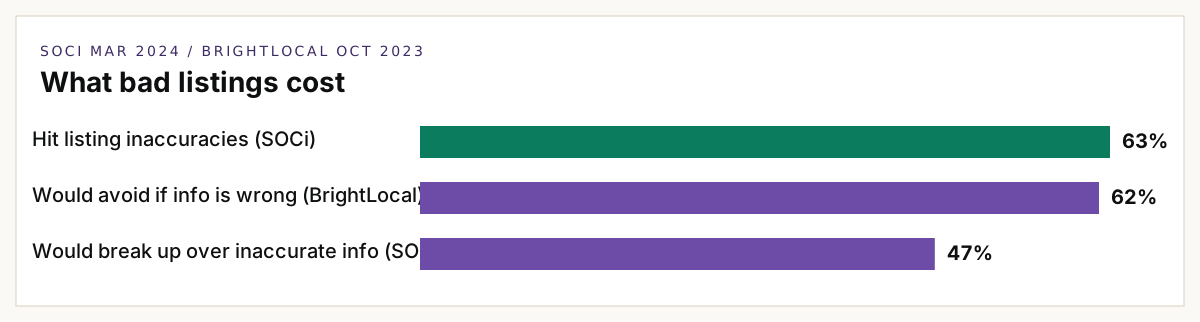
- 47% say inaccurate online information would make them "break up" with a business and choose a competitor (SOCi, Mar 2024).
- 15% of consumers default to Google Maps as their first port of call for local-specific searches (BrightLocal, Apr 2025).
- Only 35% of surveyed SMBs say they have a Google Business Profile. That is an SMB panel, not a law-firm incidence rate (BrightLocal, Aug 2025).
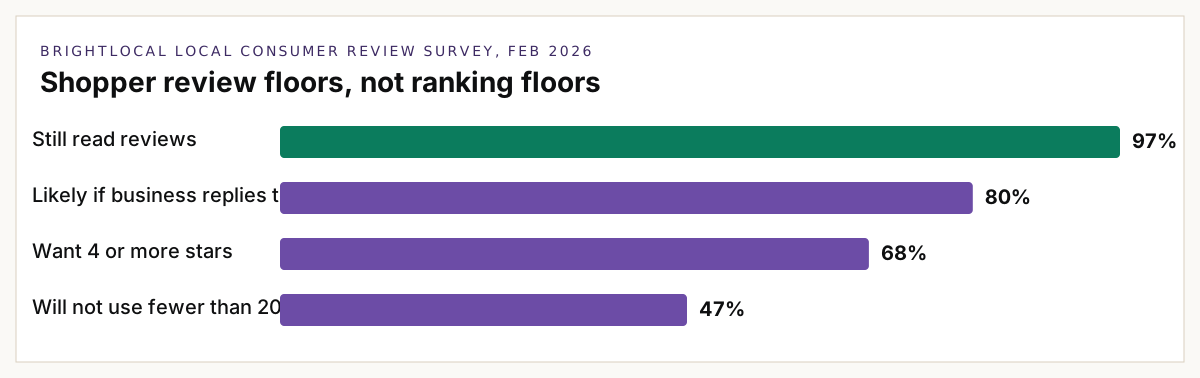
- 97% of consumers still read reviews for local businesses (BrightLocal, Feb 2026).
- 47% of consumers will not use a business with fewer than 20 reviews. That is a shopper threshold, not a Google ranking floor (BrightLocal, Feb 2026).
- 80% of consumers are likely to use a business that responds to all of its reviews, and 19% now expect a same-day reply (BrightLocal, Feb 2026).
- 94% of local pack results in BrightLocal's near-me SERP check showed no evidence of "near me" on-page stuffing (BrightLocal, Jun 2025).
- Primary GBP category is the top-ranked local pack/Maps factor in the 2026 expert survey, with a score of 227 (Whitespark, Nov 2025).
- Proximity of address to the point of search ranks second for pack/Maps, with a score of 225 (Whitespark, Nov 2025).
- "Business is open at time of search" is a new factor that ranks fifth for pack/Maps, with a score of 189. Darren Shaw notes that ranking bump is awkward for appointment businesses researched at night (Whitespark, Nov 2025).
- HTML NAP matching GBP NAP ranks 15th for pack/Maps, with a score of 153 (Whitespark, Nov 2025).
- 68% of consumers will only use a business with four or more stars, up from 55% in 2025 (BrightLocal, Feb 2026).
- Conduit Law ships 508 location pages as public architecture proof, not as a pack-share or ranking guarantee (LawVert, Sep 2026).
How do consumers start local discovery, and why Maps matter?
The demand is local and it is frequent. The first screen is often Maps, not a blog post. If the profile is incomplete, the shortlist never includes you. This is not a license to invent map-pack click-share percentages. Those listicles do not have a methodologied origin on this pass.
How often do U.S. consumers search for local businesses online?
SOCi's Consumer Behavior Index is a cross-industry panel of more than 1,000 U.S. consumers, not a lawyer-only census. Treat it as weekly local demand, then measure your own markets.
- 32% of surveyed consumers search online for local businesses every day or multiple times a day (SOCi, Mar 2024).
- 84% find new products, services, or businesses online via social feeds, search results, or recommendations (SOCi, Mar 2024).
- The recap reports a survey of over 1,000 U.S. consumers. The PDF takeaways state a panel of 1,002 (SOCi, Mar 2024).
- Google Search and Google Maps are the most frequently used apps for local research in the prior month on the recap chart, with Facebook third (SOCi, Mar 2024).
Which platforms do they default to for local search: Google vs Maps?
BrightLocal asked 1,000 U.S. adults where they start. Google still leads. Maps takes a real slice. Social is a Gen Z story, not a reason to skip GBP.
- For local-specific searches, 45% of consumers default to Google (BrightLocal, Apr 2025).
- Combining Google with Safari, which uses Google Search, the local default share is 53% (BrightLocal, Apr 2025).
- Google Maps, Apple Maps, and Bing Maps combined account for 20% of default local platforms. Social platforms grouped are first for 14% of consumers, and for 26% of Gen Z (BrightLocal, Apr 2025).
- 39% of consumers estimate that at least 41% of their searches are for local-business information. BrightLocal explicitly refuses to confirm the old "46% of Google searches are local" anecdote (BrightLocal, Apr 2025).
- After a local search, 67% often or always look at reviews, 56% check that business info matches other online mentions, and 49% plan a travel route (BrightLocal, Apr 2025).
- 85% consider presence of contact information and opening hours an important factor, and 46% call it "very important," beating price and proximity on this deal-breaker list. The study used 1,000 U.S. adults via SurveyMonkey, published April 29, 2025 (BrightLocal, Apr 2025).
What does Google say local results are based on: relevance, distance, and prominence?
Google publishes the pillars. It does not publish pack CTR. Do not fill that gap with agency listicles.
- Local results are mainly based on relevance, distance, and prominence (popularity) (Google Business Profile Help, Sep 2026).
- There is no way to request or pay for a better local ranking (Google Business Profile Help, Sep 2026).
- Prominence includes how well-known a business is, including how many websites link to it and how many reviews it has. More reviews and positive ratings can help (Google Business Profile Help, Sep 2026).
- Businesses with complete and accurate info are more likely to show in local results (Google Business Profile Help, Sep 2026).
- Verify the business so Google knows you are authorized to represent it (Google Business Profile Help, Sep 2026).
- Keep hours, category, and address current. Respond to reviews. Add photos and videos (Google Business Profile Help, Sep 2026).
- A Business Profile lets a firm manage how it shows up on Maps and Search at no charge, including hours, website, phone, and location (Google Business Profile Help, Sep 2026).
What signals do local experts weight for the map pack?
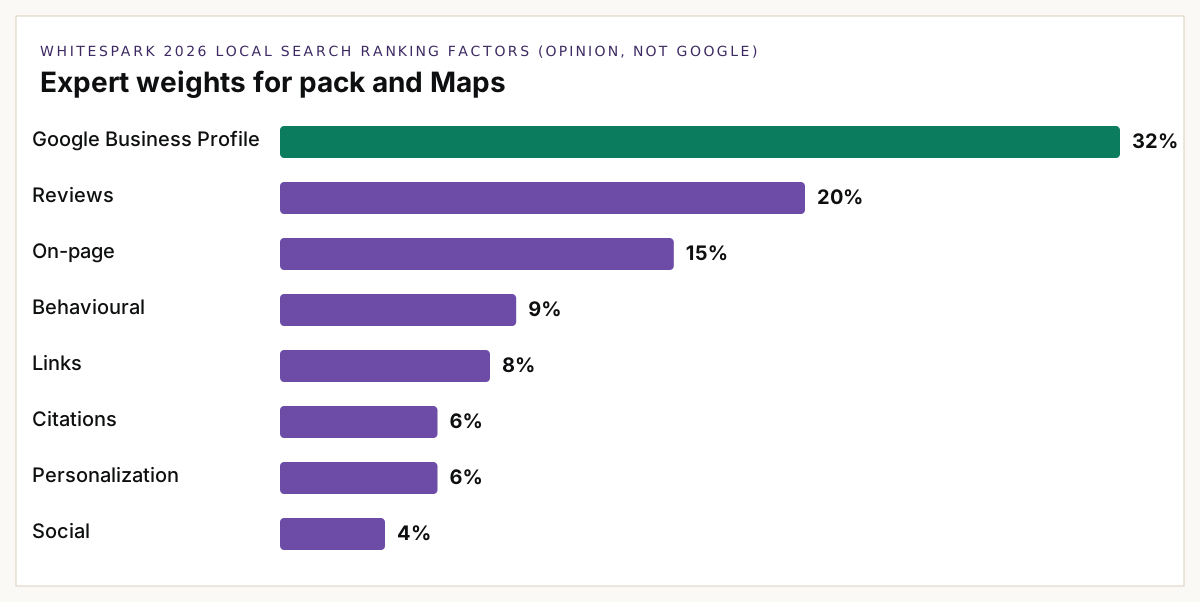
Whitespark asked 47 local SEO experts to score 187 factors. The group percentages and rank order are survey consensus about Google, not a Google algorithm disclosure. Chart labels below match the 2026 pack/Maps split corroborated on origin (GBP about 32%, reviews about 20%, on-page about 15%, behavioural about 9%, links about 8%, citations about 6%, personalization about 6%, social about 4%).
How do experts weight GBP vs review vs on-page vs citation groups for pack and Maps?
Use the group chart as a priority map. Do not quote it as Google's published weights.
- The 2026 Local Search Ranking Factors survey covers 47 experts and 187 factors, published November 6, 2025 (Whitespark, Nov 2025).
- None of the experts have special access to Google's local algorithm. The scores are expert observation and testing (Whitespark, Nov 2025).
- For local pack/Maps, experts weight Google Business Profile signals at about 32% (Whitespark, Nov 2025).
- Review signals are weighted at about 20% for pack/Maps (Whitespark, Nov 2025).
- On-page signals are weighted at about 15% for pack/Maps (Whitespark, Nov 2025).
- Behavioural signals are weighted at about 9% for pack/Maps (Whitespark, Nov 2025).
- Link signals are weighted at about 8% for pack/Maps (Whitespark, Nov 2025).
- Citation signals are weighted at about 6% for pack/Maps (Whitespark, Nov 2025).
- Personalization signals are weighted at about 6% for pack/Maps (Whitespark, Nov 2025).
- Social signals are weighted at about 4% for pack/Maps (Whitespark, Nov 2025).
- For local organic (the blue links under the pack), on-page signals are weighted at about 33% and link signals at about 24% (Whitespark, Nov 2025).
- For AI Search visibility, on-page is about 24%, reviews about 16%, and citations about 13%. Three of the top five AI-visibility factors are citation-related (Whitespark, Nov 2025).
- Review signals and behavioural signals increased versus prior editions. Citations edged down about half a percentage point for pack, while remaining foundational for AI Search visibility (Whitespark, Nov 2025).
- 47 new factors were added in 2026, and some new factors shot into the pack/Maps top ten (Whitespark, Nov 2025).
Which individual pack factors score highest after category and proximity?
The rank list is expert scoring (0 to 5, summed). It is not a LawVert ranking promise.
- Keywords in the GBP business title rank third for pack/Maps, with a score of 223 (Whitespark, Nov 2025).
- Physical address in the city of search ranks fourth, with a score of 213 (Whitespark, Nov 2025).
- High numerical Google ratings (for example 4 to 5) rank sixth, with a score of 181 (Whitespark, Nov 2025).
- Address showing on GBP (not a hidden service-area business) ranks seventh, with a score of 176 (Whitespark, Nov 2025).
- Additional GBP categories rank eighth, with a score of 173 (Whitespark, Nov 2025).
- Quantity of native Google reviews with text ranks ninth, with a score of 170 (Whitespark, Nov 2025).
- Proper placement of the map pin ranks tenth, with a score of 165 (Whitespark, Nov 2025).
- Recency of reviews ranks 11th, with a score of 164 (Whitespark, Nov 2025).
- Proximity of address to centroid ranks 12th, with a score of 157 (Whitespark, Nov 2025).
- Click-through rate from local pack/Maps results ranks 13th, with a score of 156. That is an expert behavioural factor, not a published pack CTR band (Whitespark, Nov 2025).
- Sustained influx of reviews over time, rather than bursts, ranks 14th, with a score of 154 (Whitespark, Nov 2025).
- Proper hours set on GBP ranks 21st, with a score of 134, up 64 positions from the prior edition (Whitespark, Nov 2025).
- Presence of GBP predefined services ranks 22nd, with a score of 134. The factor was near myth status in 2023 and was added after later testing (Whitespark, Nov 2025).
- Verified GBP ranks 29th for pack/Maps, with a score of 123 (Whitespark, Nov 2025).
- On the conversion-factor companion table, high numerical Google ratings rank first with a score of 213, and positive sentiment in review text ranks second with a score of 179 (Whitespark, Nov 2025).
- Local Services Ads are a paid product. Depth belongs on the ads hub. As local-SERP context only, Whitespark's LSA factor list ranks budget and bidding first (score 32) and reviews second (score 31) (Whitespark, Nov 2025).
Where do HTML NAP match and GBP completeness sit on the same factor list?
NAP match and completeness are mid-pack, not optional. Citation consistency still scores. That is expert ranking, not a Google weight table.
- Completeness of GBP ranks 16th for pack/Maps, with a score of 147 (Whitespark, Nov 2025).
- Consistency of citations on primary search engines (Google Maps, Bing Maps, Apple Maps) ranks 28th, with a score of 124 (Whitespark, Nov 2025).
- Consistency of citations on key sites (Yellowpages, Yelp, D&B, CityGrid) ranks 63rd, with a score of 101 (Whitespark, Nov 2025).
- Quality and authority of structured citations ranks 49th, with a score of 105 (Whitespark, Nov 2025).
- Quality and authority of unstructured citations (newspaper articles, blog posts, government sites, industry associations) ranks 64th, with a score of 101 (Whitespark, Nov 2025).
- NAP in schema/JSON-LD on the GBP landing page ranks 118th for pack/Maps, with a score of 73 (Whitespark, Nov 2025).
- Absence of crawlable NAP on the website ranks 10th among negative ranking factors, with a score of 121 (Whitespark, Nov 2025).
- Mismatch address on the GBP landing page ranks 15th among negative factors, with a score of 110 (Whitespark, Nov 2025).
- An address that is a P.O. box, UPS mail store, virtual office, or other false address ranks first among GBP suspension-risk factors, with a score of 202 (Whitespark, Nov 2025).
- Incorrect primary category ranks second among negative ranking factors, with a score of 214 (Whitespark, Nov 2025).
- Business marked as permanently closed ranks first among negative ranking factors, with a score of 217 (Whitespark, Nov 2025).
- Length of title tag ranks 185th for pack/Maps, with a score of 26. Whitespark calls title-tag length an SEO myth (Whitespark, Nov 2025).
How do reviews shape trust and shortlists?
Consumers still lean on reviews. The floors moved: more stars, newer dates, replies to every review. Those are shopper thresholds. Pair them with Whitespark review-factor ranks. Do not blend the two into one "algorithm percent."
How many consumers still lean on reviews, and on Google specifically?
Google remains first for finding reviews. Share dipped. AI tools and video are the 2026 story, as review UX, not as a FirmOps product claim.
- Google remains the number-one place consumers find reviews, but share dipped from 83% in 2025 to 71% in 2026. 41% "always" read reviews, up from 29%, and the average consumer uses six review sites. Panel: 1,002 U.S. adults via SurveyMonkey (BrightLocal, Feb 2026).
- Use of ChatGPT and other generative AI tools for local recommendations rose from 6% to 45%, becoming the third most popular source of business recommendations. Treat that as review UX, not a legal-AI product claim (BrightLocal, Feb 2026).
- 94% of consumers are open to writing a review. 78% were asked, and 83% of those asked went on to leave one (BrightLocal, Feb 2026).
- In the 2025 edition, 42% of consumers said they trust reviews as much as personal recommendations, down from 79% in 2020 on that page's historical series (BrightLocal, Jan 2025).
What review volume, recency, and star floors make consumers walk away?
Volume, recency, and stars are three different walk-away rules. None of them is Google's ranking threshold.
- Only 9% of consumers will use a business with five or fewer reviews. 74% only care about reviews written in the last three months, and 32% look for reviews from the last two weeks, up from 20% (BrightLocal, Feb 2026).
- 92% of consumers care about star ratings. 31% will only use a business with 4.5 or more stars, up from 17% the prior year (BrightLocal, Feb 2026).
- Consistent sentiment across multiple reviews is the top review-quality factor (56%). After positive reviews, 54% visit the website and 66% do further research, while 34% are ready to buy or book (BrightLocal, Feb 2026).
How strongly do response rate and owner replies affect likelihood to use a business?
Silence is a ranking of its own, among shoppers. Templated replies are not a shortcut.
- 42% of consumers are unlikely to use a business that ignores reviews entirely. 89% expect owners to respond. 32% want a reply by the following day, up from 18%, and 81% expect a reply within a week (BrightLocal, Feb 2026).
- Templated or generic responses put off 50% of consumers. "The business owner has responded" ranks among the top positive-feeling factors, cited by 37% (BrightLocal, Feb 2026).
- Google says that when you reply to customer reviews, it shows you value their feedback, and that positive reviews and helpful replies can help a business stand out (Google Business Profile Help, Sep 2026).
If reviews are the shortlist and replies are the trust test, the next question is whether the firm can actually take the call. Book a 15-minute strategy call.
How should firms treat "near me": consumer behavior, not doorway spam?
People still type "near me." Pack winners mostly do not stuff it. Proximity and a real location page beat a laundry-list mill. The commercial hub already bans thin city templates. These stats are the consumer proof, not a mill license.
How often do consumers still type "near me," and is volume rising or falling?
The phrase is common. The volume trend is down. Search engines already understand local intent.
- 46% of consumers say they always or often add "near me" to local queries, while Ahrefs-based volume for the studied industry terms is down 19% from 2021 to 2024. BrightLocal's short answer on stuffing "near me" into web copy is no (BrightLocal, Jun 2025).
Do map-pack winners show "near me" on-page optimizations, or proximity instead?
The pack is a proximity surface. Organic is closer to on-page. Stuffing "near me" is not what the winners are doing.
- Only 6% of local pack results showed evidence of "near me" on-page optimization. Across pack plus organic, 31% showed that optimization and 69% did not. Organic alone was closer to 48% / 52%. BrightLocal concludes the pack prioritizes location and proximity (BrightLocal, Jun 2025).
- Google's spam policies describe doorway abuse as pages targeted at specific regions or cities that funnel users to one page, and as substantially similar pages (Google Search Central, Sep 2026).
- Keyword stuffing includes blocks of text that list cities and regions a page is trying to rank for (Google Search Central, Sep 2026).
- Google's SEO starter guide says each piece of content should be accessible through one URL, and that unique, people-first content is the job (Google Search Central, Sep 2026).
What share of pack listings lack a website URL, and why that is not a mill license?
A missing URL can still rank on proximity. That is not permission to ship empty city pages. Consumers still need a site they can trust.
- 24% of local pack results had no website URL on the GBP, and another 4% had expired or broken URLs. BrightLocal still recommends the GBP URL point to the most relevant page, often a location page (BrightLocal, Jun 2025).
How often do NAP and listing errors break trust?
Wrong hours and mismatched NAP are not a citation-building footnote. They are a breakup event. SOCi is the non-BrightLocal primary. Google's representation guidelines are the floor.
How often do consumers hit inaccurate listings, and how many switch competitors?
Inaccuracy is common. Switching is the cost.
- Nearly two in three consumers (63%) have encountered inaccuracies in business listings on major platforms such as Google, Facebook, and Instagram (SOCi, Mar 2024).
- 62% of consumers would avoid using a business if they found incorrect information online, in BrightLocal's 2023 Discovery and Trust survey of 1,138 U.S. consumers. The most trusted research platforms were Google (66%), Google Maps (45%), and a business's own website (36%) (BrightLocal, Oct 2023).
- 7% would abandon the search entirely after an incorrect address (versus 3% in 2021), and 23% come across fake listings at least once a month (BrightLocal, Oct 2023).
How important are contact info and hours when choosing a local business?
Contact and hours beat price on BrightLocal's deal-breaker list. That finding is already in the Maps section. The operator implication is NAP hygiene, not another percentage.
What do Google representation guidelines and Whitespark citation and NAP factors require?
Google's language is the NAP rule. Whitespark's ranks are expert opinion sitting on top of that floor.
- Represent the business as it is consistently represented in the real world across signage, stationery, and other branding (Google Business Profile Help, Sep 2026).
- There should be only one profile per business (Google Business Profile Help, Sep 2026).
- Use a precise, accurate address. P.O. boxes and remote mailboxes are not acceptable (Google Business Profile Help, Sep 2026).
- Provide a phone number that connects to the individual location, or a website that represents that location. Do not redirect callers or visitors to a different business (Google Business Profile Help, Sep 2026).
- Choose the fewest categories that describe the overall core business. Categories should complete "this business IS a," not "this business HAS a" (Google Business Profile Help, Sep 2026).
- Lawyers who are public-facing and reachable at the verified location may have a practitioner profile. A practitioner should not mint multiple profiles to cover specializations (Google Business Profile Help, Sep 2026).
- Claim and verify a Business Profile so you can provide address, contact info, business type, and photos. That information can show on Maps and in a knowledge panel (Google Search Central, Sep 2026).
- Define each location as a LocalBusiness. Required properties include name and address. Schema is not a ranking cheat code (Google Search Central, Sep 2026).
- Service-area businesses should hide the address when they do not have a customer-facing storefront. Showing an address when the business is a service-area business is a new negative/suspension-risk factor in the Whitespark survey (Google Business Profile Help, Sep 2026).
If GBP, the site footer, and the directories print three different phones, the entity looks like three firms. Book a 15-minute strategy call.
How widely is GBP adopted, and what does "complete" buy?
Everyone says they invest in local SEO. Many SMBs still lack the pack's front door. Do not rewrite the SMB panel as "35% of law firms." Google's complete-and-accurate language is the floor. The widely cited 2.7 times / 70% / 50% marketing triad is not used here because the original Google marketing URL was not retrieved live.
What share of SMBs report having a Google Business Profile?
The gap is the operator wedge: investment without the listing.
- Only 40% of surveyed SMBs have a dedicated business website, despite 89% saying they invest in organic SEO or local SEO. The panel is 778 U.S. SMB owners or managers, not law firms (BrightLocal, Aug 2025).
- Just 17% of SMBs say they use business directories, and 54% of small business owners manage marketing on their own (BrightLocal, Aug 2025).
How does that gap sit against SMBs who say they invest in local SEO?
Investment is not impact. Impact self-ratings are lower than the spend claim.
- Despite that investment claim, less than one third (29%) of local-SEO investors rate local SEO as high impact, and 36% feel it has little or no impact (BrightLocal, Aug 2025).
- Facebook (50%) and Instagram (44%) outrank a dedicated website as platforms SMBs use to market themselves online (BrightLocal, Aug 2025).
What does Google say about complete, accurate Business Profile info and local visibility?
Complete is a Help-language floor, not a multiplier we could not verify on origin.
- After verification, complete the profile, including services that match the work you take (Google Business Profile Help, Sep 2026).
- Provide full address if customers can visit, business hours including special hours, category, and attributes such as parking (Google Business Profile Help, Sep 2026).
- If business info is not accurate, the profile might not show for relevant searches in the area (Google Business Profile Help, Sep 2026).
- Google can also detect category information from the website and from mentions about the business throughout the web (Google Business Profile Help, Sep 2026).
- LocalBusiness structured data can include hours, departments, geo coordinates, telephone, and URL as recommended properties on top of required name and address (Google Search Central, Sep 2026).
The pack's front door is a complete, honest GBP plus city pages that can take the case. Book a 15-minute strategy call.
What outcomes look like when local architecture reaches intake?
Public proof is one firm. Intake still dies on unanswered phones. Speed is a tease, not this hub's essay. No invented Conduit pack-share, no ranking guarantee, no ROI claim.
What public Search Console, location-page stack, and SEO-attributed signed figures does LawVert publish for Conduit Law?
Cite only the public case study. Historical one-firm results. Prefer the local hooks: location pages, mobile, schema, NAP alignment.
- Property `sc-domain:conduit.law`, web search, October 13, 2025 through August 21, 2026: 7.61K Google clicks, 2.0M impressions, 0.4% CTR, average position 23.9 (LawVert, Sep 2026).
- Monthly clicks rose 9.2 times from December 2025 (224) to July 2026 (2,060) (LawVert, Sep 2026).
- Trailing year ending August 25, 2026: 162 organic-search leads and 66 SEO-attributed signed cases (LawVert, Sep 2026).
- Stack: 668+ indexed pages, 25 practice areas, and 91 blog posts, with city pages citing courts, corridors, and trauma centers and NAP aligned with GBP (LawVert, Sep 2026).
- In July 2026, 70% of clicks were mobile (LawVert, Sep 2026).
- Schema on major templates includes Organization, LegalService, FAQPage, and BreadcrumbList (LawVert, Sep 2026).
How often do secret-shopped firms answer the phone or email after a discovery path?
Tease only. Pack and GBP traffic still dies at intake. Depth on site-as-product lives on law firm website design. National SERP economics live on law firm SEO.
- Of 500 U.S. firms contacted June 20 to July 5, 2024, only 40% answered the phone, down from 56% in 2019 (Clio, Oct 2024).
- Including call-backs, only 52% were reachable by phone, so 48% were unreachable (Clio, Oct 2024).
- Of firms emailed, only 33% responded, down from 40% in 2019 (Clio, Oct 2024).
- 73% of secret shoppers were unlikely to recommend the firms they contacted (Clio, Oct 2024).
What share of local law firm sites pass Core Web Vitals in a competitive CrUX sample?
Tease only. Website hub owns CWV and script-stack depth. SEO hub also cites this set. Do not clone that essay here.
- Of 186 local law firms ranking for practice-area plus city queries across 32 U.S. metros (CrUX, May 2026 mobile), only 48.4% pass Core Web Vitals (PageSpeed Matters, May 2026).
- Good INP was 96.2% and good CLS 91.4%. Loading is the weak point: good LCP was 74.2%, with median LCP at 2.0 seconds (PageSpeed Matters, May 2026).
Location pages, a complete GBP, and a phone that actually answers are the same program. Book a 15-minute strategy call. Public proof remains the Conduit Law case study.
Methodology and Sources
Every number traces to the organization that produced it: SOCi's Consumer Behavior Index, BrightLocal's consumer/SMB/near-me/review reports, Google Business Profile Help and Search Central, Whitespark's 2026 expert survey, LawVert's public Conduit Law case study, Clio's Legal Trends Report (intake tease only), and PageSpeed Matters' CrUX sample (CWV tease only). Aggregator "local SEO statistics" roundups, invented map-pack CTR bands, and the unverified Google 2.7 times marketing triad are not sources. Whitespark group percentages and factor ranks are expert opinion, not Google's published algorithm weights. BrightLocal and SOCi panels are cross-industry, not a law-firm census. Conduit figures are one-firm historical proof, not a pack-share or ranking guarantee. This page is refreshed monthly. Accessed September 9, 2026.
Article Sources
- SOCi, Consumer Behavior Index 2024 recap Accessed September 9, 2026. ↩
- SOCi, 2024 Consumer Behavior Index PDF takeaways Accessed September 9, 2026. ↩
- BrightLocal, Consumer Search Behavior Accessed September 9, 2026. ↩
- BrightLocal, Local Consumer Review Survey 2026 Accessed September 9, 2026. ↩
- BrightLocal, Local Consumer Review Survey 2025 Accessed September 9, 2026. ↩
- BrightLocal, Should You Optimize for Near Me? Accessed September 9, 2026. ↩
- BrightLocal, SMB Marketing 2025 Accessed September 9, 2026. ↩
- BrightLocal, Local Business Discovery and Trust Report 2023 Accessed September 9, 2026. ↩
- Whitespark, 2026 Local Search Ranking Factors Accessed September 9, 2026. ↩
- Google Business Profile Help, Tips to improve your local ranking Accessed September 9, 2026. ↩
- Google Business Profile Help, Get started with Google Business Profile Accessed September 9, 2026. ↩
- Google Business Profile Help, Guidelines for representing your business Accessed September 9, 2026. ↩
- Google Business Profile Help, Complete your Business Profile Accessed September 9, 2026. ↩
- Google Search Central, Establish your business details Accessed September 9, 2026. ↩
- Google Search Central, LocalBusiness structured data Accessed September 9, 2026. ↩
- Google Search Central, Spam policies Accessed September 9, 2026. ↩
- Google Search Central, SEO Starter Guide Accessed September 9, 2026. ↩
- LawVert, Conduit Law case study Accessed September 9, 2026. ↩
- Clio, 2024 Legal Trends Report (PDF) Accessed September 9, 2026. ↩
- Clio, Legal Trends Report press Accessed September 9, 2026. ↩
- PageSpeed Matters, Law Firm Website Speed 2026 Accessed September 9, 2026. ↩
Glossary
- GBP: Google Business Profile, the listing that can appear on Maps and in the local pack.
- Map pack / local pack: The local results block (often a map plus three businesses) on Search and Maps.
- NAP: Name, address, and phone, which should match across GBP, the site, and citations.
- LocalBusiness / JSON-LD: Schema.org markup for a location. Required properties include name and address.
- Proximity: Distance from the searcher (or from Google's centroid) to the business pin.
- Prominence: Google's published popularity factor, including links and reviews.
- SAB: Service-area business, which serves customers at their locations and often hides its address.
- CrUX / CWV: Chrome UX Report field data and Core Web Vitals. Teased here. Depth on the website hub.
- LSA: Local Services Ads, a paid product. Teased here as local-SERP context only.
- GSC: Google Search Console.
- SMB: Small and medium-sized business. BrightLocal's GBP adoption figure is an SMB panel, not attorneys.
- GEO / AIO / zero-click: National SERP and AI Overview economics. Teased only. See law firm SEO.
- Primary source: The organization that originally produced the data or the Help text.
- Aggregator: A page that republishes other people's stats without producing the data.
Related LawVert reading
After reviews, NAP, and GBP
Local architecture still has to reach intake
A complete profile and honest city pages are the local job. Public proof is only the Conduit Law case study. We do not publish pack-share percentages or a ranking guarantee.
Book a callNext step
Bring the markets and the GBP
Book a 15-minute strategy call. The stats describe the pack, the listing, and the review floor. The call is whether LawVert under Cadence MSO should run local as operations. No ranking promise. No invented pack share.
Book a callPrefer to email first? hello@lawvert.com · Send a note