Law firm SEO statistics
171 Law Firm SEO Statistics 2026
Primary sources only. SparkToro panels are not interchangeable. Pew visit-clicks are not Seer impression CTR.
Updated SEPTEMBER 2026
Written by Jonathan Mahler, reviewed by Jonathan Mahler. Operator notes, not legal advice.
Google still gets the query. The open web gets a smaller slice of the click. Law firm SEO that stops at a ranking screenshot is measuring the wrong layer. This page is the citation ledger for organic programs. The operator guide lives on law firm SEO. Map-pack and GBP depth live on law firm local SEO. Do not merge those URLs.
Zero-click, AI Overview, Core Web Vitals, and schema figures below are cross-web unless a source names a legal sample. SparkToro's 2026 panel is Similarweb. Its 2024 twin is Datos. Pew counts visits with a click. Seer counts impression CTR. Those are different units. This page never blends them into one "the" click-through rate. Updated September 2026.
Key Takeaways
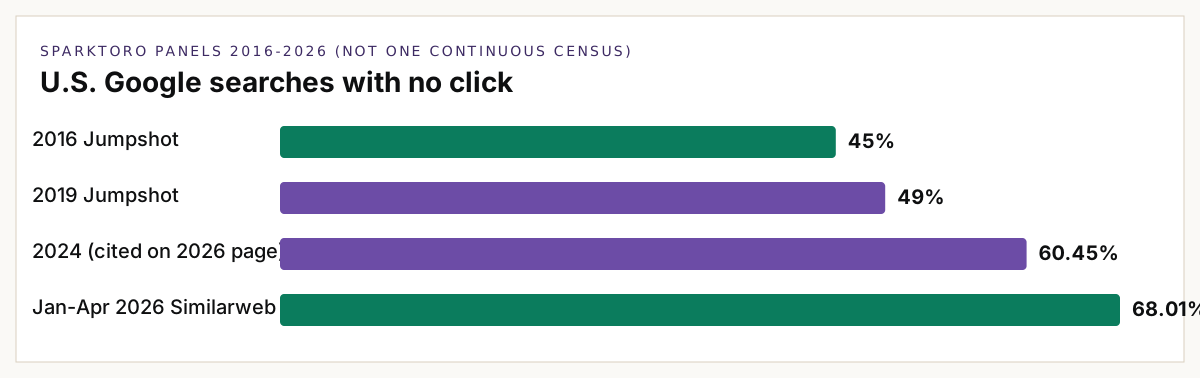
- In January through April 2026, 68.01% of U.S. Google searches ended without a click (SparkToro, Jun 2026).
- For every 1,000 U.S. Google searches in the 2024 Datos panel, only 360 clicks reached the open web (SparkToro, Jul 2024).
- Users who saw an AI summary clicked a traditional result in 8% of visits, versus 15% of visits without a summary (Pew Research Center, Jul 2025).
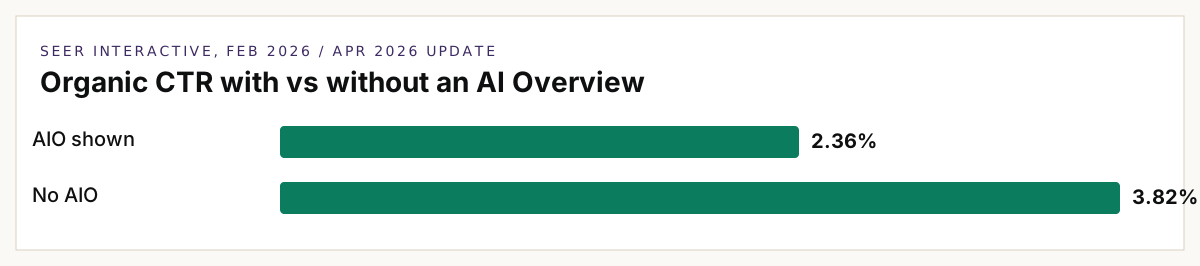
- In February 2026, organic CTR was 2.36% when an AI Overview was shown and 3.82% when it was not (Seer Interactive, Apr 2026).
- Just 30% of law firm websites give clear hiring-process guidance, and 14% display pricing (Clio, Oct 2024).
- SEO providers in Ahrefs' poll of 439 sellers charge $2,917 per month on average. That is a provider price, not a law-firm invoice (Ahrefs, Aug 2024).
- In the 2025 Web Almanac, 48% of mobile websites achieve good Core Web Vitals on all three metrics (HTTP Archive, Jan 2026).
- Of 186 local law firms ranking for practice-area-plus-city queries across 32 U.S. metros, 48.4% pass Core Web Vitals on mobile (PageSpeed Matters, Jul 2026).
- Structured data appeared on 51.25% of HTML pages in the October 2024 Common Crawl extract (Web Data Commons, Jan 2025).
- Being cited in an AI Overview delivers about 120% more organic clicks per impression than being uncited on the same AIO SERP, and still underperforms no-AIO by about 38% (Seer Interactive, Apr 2026).
- 74% of surveyed lawyers use the firm website to promote services, while shoppers still struggle to find hiring steps or pricing (Clio, Oct 2024).
- On conduit.law, monthly Google clicks rose 9.2 times from December 2025 (224) to July 2026 (2,060). Historical one-firm results, not a promise (LawVert, Sep 2026).
How much organic click share is left in Google search?
The remaining click is not a rounding error. It is the inventory a law firm SEO program actually buys. Cross-web clickstream is not a legal-SERP census. Attribute the panel before you treat a percentage as a trend line.
What share of Google searches end with zero clicks in the latest SparkToro / Similarweb panel?
The 2026 series is Similarweb desktop and mobile web, January through April, United States. It is not the 2024 Datos panel, and it is not the Google Search app.
- The 2024 U.S. zero-click figure cited on the same 2026 page is 60.45%, a 7.5 point rise (about 12.5% relative) over two years (SparkToro, Jun 2026).
- Searches that produced at least one click of any kind fell 9.51 points, a 22.9% relative decline versus the 2024 comparison (SparkToro, Jun 2026).
- The share of searchers who ran another query rose 7.2 points from 2024 to 2026 (SparkToro, Jun 2026).
- AI Mode accounted for 0.34% of searches in January through April 2026 (SparkToro, Jun 2026).
- SparkToro's 2019 Jumpshot series found 49% of Google searches ended without a click (SparkToro, Jun 2026).
- About 45% of Google searches were zero-click ten years earlier in the 2016 Jumpshot series (SparkToro, Jun 2026).
- That is a 23 point, 33.8% relative increase in zero-click share across the decade of published panels (SparkToro, Jun 2026).
- Mobile versus desktop split in the 2026 study is weighted at about two-thirds mobile and one-third desktop (SparkToro, Jun 2026).
- The 2026 clickstream excludes the Google mobile search app, where zero-click features are more aggressive, so the published rate is likely a floor (SparkToro, Jun 2026).
How does that compare to the 2024 SparkToro / Datos baseline (panel whiplash)?
Do not draw a continuous census across Datos and Similarweb. Quote both. Label both.
- In 2024, 58.5% of U.S. Google searches were zero-click (SparkToro, Jul 2024).
- In the same study, 59.7% of EU Google searches were zero-click (SparkToro, Jul 2024).
- About 30% of U.S. clicks went to Google-owned properties (SparkToro, Jul 2024).
- Roughly 20% of searches that produced at least one click produced more than one click (SparkToro, Jul 2024).
- Universally, about 22% of searches resulted in another search (SparkToro, Jul 2024).
- Searchers either ended the session entirely about 37% of the time or changed the query about 22% of the time inside the zero-click bucket (SparkToro, Jul 2024).
- Almost half of mobile searches in both the U.S. and EU ended the browsing session, more than twice the desktop share (SparkToro, Jul 2024).
- The Datos panel covers September 2022 through May 2024 (SparkToro, Jul 2024).
- Device mix used Sistrix 2023 baselines: 63% of U.S. searches on mobile and 64.7% in the EU (SparkToro, Jul 2024).
- Paid clicks were about 1% of all clicks in that panel, including the many queries with no ad on the page (SparkToro, Jul 2024).
How many clicks per 1,000 searches still reach the open web?
The EU twin is the clean comparison for the U.S. open-web rate in Key Takeaways. Google-property clicks are not open-web clicks.
- For every 1,000 Google searches in the EU, 374 clicks reached the open web (SparkToro, Jul 2024).
- Google stated in 2023 that less than 20% of search queries contain a paid ad, which SparkToro used to reconcile the low paid-click share (SparkToro, Jul 2024).
- EU mobile searchers were almost 50% more likely than U.S. mobile searchers to click a Google paid search ad (SparkToro, Jul 2024).
How do AI Overviews change organic CTR?
Pew is visit-level browsing. Seer is impression CTR across a multi-brand panel. Ahrefs is position-one CTR on keyword samples. Quote the unit. Never average them into one suppression rate. None of these panels is legal-SERP-only.
What does Pew's metered browsing study show when an AI summary appears?
Nine hundred U.S. adults shared browse data for March 2025. Pew then recrawled those queries. That is a people panel, not a GSC export.
- Clicks on links inside the AI summary itself occurred in 1% of visits to summary pages (Pew Research Center, Jul 2025).
- The session ended after 26% of AI-summary pages versus 16% of pages without a summary (Pew Research Center, Jul 2025).
- About 18% of Google searches in the March 2025 study produced an AI summary (Pew Research Center, Jul 2025).
- 58% of respondents conducted at least one Google search that month that produced an AI-generated summary (Pew Research Center, Jul 2025).
- The dataset contains 68,879 unique Google searches (Pew Research Center, Jul 2025).
- 12,593 of those searches produced an AI summary (Pew Research Center, Jul 2025).
- 88% of those summaries cited three or more sources, and only 1% cited a single source (Pew Research Center, Jul 2025).
- The median AI summary was 67 words; the shortest was 7 words and the longest 369 (Pew Research Center, Jul 2025).
- 8% of one- or two-word searches produced an AI summary, versus 53% of searches with 10 or more words (Pew Research Center, Jul 2025).
- 60% of queries that began with question words such as who, what, when, or why produced an AI summary (Pew Research Center, Jul 2025).
- 36% of searches that included both a noun and a verb generated an AI summary (Pew Research Center, Jul 2025).
- Wikipedia, YouTube, and Reddit together accounted for 15% of sources listed in AI summaries and 17% of sources in standard results (Pew Research Center, Jul 2025).
- .gov sites were 6% of AI-summary sources versus 2% of standard-result sources (Pew Research Center, Jul 2025).
What longitudinal CTR gap does Seer Interactive report for AIO-present vs AIO-absent queries?
Seer's 2026 update is 53 brands, 5.47 million tracked queries, and 2.43 billion organic impressions from January 2025 through February 2026. Agency R&D, not a legal-vertical census.
- The cohort also includes 296.9 million paid impressions (Seer Interactive, Apr 2026).
- Organic CTR on AIO-present queries fell to a 1.31% floor in December 2025 before rebounding in early 2026 (Seer Interactive, Apr 2026).
- That rebound is about an 85% increase off the December floor (Seer Interactive, Apr 2026).
- January 2025 AIO-present organic CTR started near 3.2% (Seer Interactive, Apr 2026).
- Informational queries showed an AI Overview about 36% of the time (Seer Interactive, Apr 2026).
- Transactional queries showed an AI Overview about 5% of the time (Seer Interactive, Apr 2026).
- Commercial queries showed an AI Overview about 8% of the time (Seer Interactive, Apr 2026).
- Comparison queries triggered an AI Overview 95.4% of the time (267 of 280 tracked comparison queries) (Seer Interactive, Apr 2026).
- Question-format queries triggered an AI Overview 85.9% of the time (1,214 of 1,413) (Seer Interactive, Apr 2026).
- Informational "near me" queries showed AI Overviews 76.9% of the time. That is a SERP-feature observation, not a map-pack ranking table. Map-pack depth lives on law firm local SEO (Seer Interactive, Apr 2026).
- Single-word informational queries still triggered an AI Overview 27.3% of the time (Seer Interactive, Apr 2026).
- For every 1 million informational impressions: about 33,500 organic clicks with no AIO, 20,743 when the brand is cited, and 9,445 when the brand is not cited (Seer Interactive, Apr 2026).
- Organic CTR on AIO SERPs where the brand was not cited declined 67% across 2025 (Seer Interactive, Apr 2026).
- Informational no-AIO organic CTR improved from 2.93% in January 2025 to 3.97% in December 2025 (Seer Interactive, Apr 2026).
- Paid CTR with no AIO fell from 26% in January 2025 to 21.8% in February 2026 (Seer Interactive, Apr 2026).
- Paid CTR with an AIO rose from 14.6% to 16.2% over that window (Seer Interactive, Apr 2026).
Does earning an AIO citation recover clicks relative to uncited brands on the same SERP?
A citation beats the uncited row on that SERP. It does not restore the no-AIO baseline. Ahrefs measures a different thing: position-one CTR on keyword samples with and without an Overview.
- In September 2025, brand-cited organic impressions were 15,797,234 with 398,798 clicks (2.52% CTR) (Seer Interactive, Apr 2026).
- In October 2025, those impressions more than doubled to 33,100,739 while clicks stayed about 400,271 (1.21% CTR) (Seer Interactive, Apr 2026).
- In November 2025, impressions reached 39,500,144 with 301,783 clicks (0.76% CTR) (Seer Interactive, Apr 2026).
- Ahrefs' December 2025 rerun found AI Overviews correlated with a 58% lower average CTR for the top-ranking page versus a forecast without Overviews (Ahrefs, Feb 2026).
- Position-one CTR on Ahrefs' AI Overview keyword sample fell from 0.073 in December 2023 to 0.016 in December 2025 (Ahrefs, Feb 2026).
- Position-one CTR on informational keywords without that AIO label fell from 0.076 to 0.039 over the same two Decembers (Ahrefs, Feb 2026).
- That study used 300,000 keywords: 150,000 with an AI Overview and 150,000 informational keywords without one (Ahrefs, Feb 2026).
- Estimated CTR impact by position included -50.8% at position 2 and -46.4% at position 3 (Ahrefs, Feb 2026).
- Across 146 million desktop SERPs in September 2025, AI Overviews appeared on 20.5% of keywords (29,991,998 of 146,122,391) (Ahrefs, Nov 2025).
- 99.9% of keywords that triggered an AI Overview were classified informational (Ahrefs, Nov 2025).
- AI Overviews appeared on 57.9% of question queries (Ahrefs, Nov 2025).
- 23.6% of Legal YMYL queries triggered an AI Overview (Ahrefs, Nov 2025).
- The Law and Government category showed a 23.1% AIO rate (Ahrefs, Nov 2025).
- Only 7.9% of local searches triggered an AI Overview. That is not a GBP ranking-factor table (Ahrefs, Nov 2025).
- 46.4% of queries with seven or more words triggered an AI Overview (Ahrefs, Nov 2025).
Why do law firm websites fail as SEO landing pages?
Rankings die at the page the click lands on. Clio's website and secret-shop chapters are all-practice, not an SEO mill census. They still describe the landing-page and first-touch gap after organic demand arrives.
How many firms' sites give clear hiring-process guidance or pricing?
The brochure is the landing page. If process and price are missing, the click has nowhere to go.
- 86% of prospective clients said it was easy to find the types of cases a firm handles on the website (Clio, Oct 2024).
- Of firms that replied to secret-shop emails, only 18% provided clear next steps or cost information (Clio, Oct 2024).
- Only 2% of 2024 emailed firms referenced similar legal situations, down from 27% in 2019 (Clio, Oct 2024).
- On phone contacts, only 41% of firms offered rate information (Clio, Oct 2024).
- Only 12% of phoned firms provided cost estimates (Clio, Oct 2024).
- Only 36% explained the legal process or outlined next steps on those calls (Clio, Oct 2024).
How often do secret-shopped firms answer the phone or email (intake gap after the click)?
This is the same Clio 2024 secret shop used on LawVert's advertising statistics hub. It belongs here as the post-click failure mode for organic landings, not as a second advertising census.
- Clio hired a third-party shop to contact 500 U.S. firms from June 20 to July 5, 2024 via email, phone, chatbot, and intake form (Clio, Oct 2024).
- Only 40% of those firms answered the first phone call, down from 56% in 2019 (Clio, Oct 2024).
- Including callbacks, only 52% were reachable by phone, so 48% were unreachable (Clio, Oct 2024).
- Of firms emailed, only 33% responded, so 67% did not respond (Clio, Oct 2024).
- Of firms that did respond to email, 84% replied within eight hours (Clio, Oct 2024).
- The 2019 phone shop reached 73% of firms when callbacks were included (Clio, Oct 2024).
- Voicemail response fell from 43% of firms in 2019 to 20% in 2024 (Clio, Oct 2024).
- Only 12% of shoppers were likely to recommend the firms they contacted (Clio, Oct 2024).
- 51% of clients find chatbots useful for exploring legal options, and 67% still want the option to speak with a person (Clio, Oct 2024).
What share of lawyers say the firm website is a primary promo channel, versus what shoppers can find?
The channel is named. The content is not. That is the SEO landing-page problem, not a paid-media problem.
- Press coverage of the same report notes 73% of shoppers were unlikely to recommend the firms they contacted (Clio, Oct 2024).
- Shoppers who reached a firm by phone were more than three times as likely to promote it as the average across channels (Clio, Oct 2024).
If the page that ranks cannot explain hiring or answer the phone, book a 15-minute strategy call. The commercial system is law firm SEO.
What does SEO cost, and what do firms actually spend on marketing?
Ahrefs polled SEO sellers. Clio measured law-firm expense mixes. Provider retainers are not buyer invoices, and marketing wallet is not an SEO line item.
What do SEO providers charge on average (agency vs freelancer retainers) in Ahrefs' provider poll?
Global seller survey. U.S. and Canada skew higher on the same page. Do not quote this as what a PI metro must pay.
- Agencies average $3,209 per month versus $1,348 for freelancers (Ahrefs, Aug 2024).
- Local SEO averages $1,557 per month (Ahrefs, Aug 2024).
- 78.2% of respondents charge a monthly retainer (Ahrefs, Aug 2024).
- 63% of pricing falls between $500 and $5,000 per month (Ahrefs, Aug 2024).
- The most common monthly band is $501 to $1,000, at 20.4% of respondents (Ahrefs, Aug 2024).
- Consultants average $3,250 per month (Ahrefs, Aug 2024).
- The average hourly rate in the poll is $111 (Ahrefs, Aug 2024).
- 34.8% charge hourly and 48.9% charge per project (Ahrefs, Aug 2024).
- 42.8% charge between $501 and $2,000 per month (Ahrefs, Aug 2024).
- 68.8% charge $2,000 per month or less (Ahrefs, Aug 2024).
- Isolated U.S. and Canada data: 79.1% charge at least $1,001 per month (Ahrefs, Aug 2024).
- 57.4% of agencies command $1,001 or more per month, versus 32.2% of freelancers (Ahrefs, Aug 2024).
- SEOs in business two years or less average $1,540.52 per month, versus $2,023.13 after two-plus years (about 33% more) (Ahrefs, Aug 2024).
- The 5 to 10 year cohort averages $3,648.28 per month (Ahrefs, Aug 2024).
- Worldwide-market sellers average $3,473.74 per month versus $1,557.08 for local-only sellers (Ahrefs, Aug 2024).
- Local SEO agencies typically charge $1,819 per month versus about $1,150 for freelancers (Ahrefs, Aug 2024).
- The most common per-project band is $2,501 to $5,000, at 21.2% of respondents (Ahrefs, Aug 2024).
What share of firm expenses goes to marketing in Clio's Legal Trends data, and how do high-productivity firms differ?
Marketing spend is the wallet. SEO is one possible line inside it. Clio's productivity bar is utilization, not a LawVert ROI claim.
- The average firm spends roughly 5% of overall expenses on marketing, growing about 8% per year (Clio, Oct 2024).
- Solo lawyers spend about 9% of expenses on marketing (Clio, Oct 2024).
- Firms with above-average productivity spend 41% more on marketing and 12% more on software, and show 21% more profitability (Clio, Oct 2024).
- That productivity bar is utilization above about 37%, or roughly three billable hours per day (Clio, Oct 2024).
- Software spending has grown about 20% annually since 2013, while revenue grew about 9% per year (Clio, Oct 2024).
- Solo software spend is 0.58% of expenses and is growing 56% annually (Clio, Oct 2024).
- Firms with 2 to 4 lawyers spend 1.77% of expenses on software; 5 to 19 spend 1.37%; 20 or more spend 1.6% (Clio, Oct 2024).
- Spending-habit figures draw on historical P&L reports from 122 solo, small, and medium-sized firms sourced with CPN Legal (Clio, Oct 2024).
Provider price is not outcome. Book a 15-minute strategy call if the question is what a managed organic program actually includes.
How widely are technical SEO floors adopted (CWV and schema)?
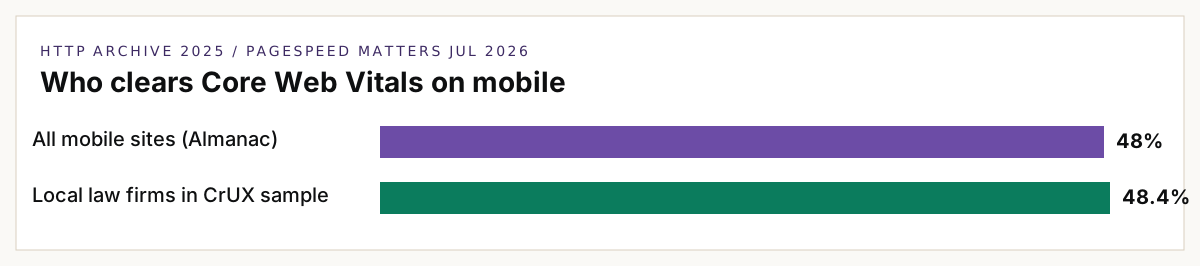
Google publishes thresholds. HTTP Archive publishes how often the web clears them. PageSpeed Matters publishes a legal competitive sample. Web Data Commons publishes markup incidence. Do not treat a Search Central rule as an industry adoption rate.
What share of the web passes Core Web Vitals (HTTP Archive / CrUX Almanac)?
Primary analysis is July 2025 CrUX and HTTP Archive. Cross-web, not law-firm-only.
- Desktop good Core Web Vitals reached 56% in 2025, up from 55% in 2024 (HTTP Archive, Jan 2026).
- Mobile good Core Web Vitals were 44% in 2024 and 36% in 2023 (HTTP Archive, Jan 2026).
- Desktop good Core Web Vitals were 48% in 2023, 44% in 2022, and 41% in 2021 (HTTP Archive, Jan 2026).
- Mobile LCP is good on 62% of sites; desktop LCP is good on 74% (HTTP Archive, Jan 2026).
- Mobile INP is good on 77% of sites, up from 74% in 2024; desktop INP is good on 97% (HTTP Archive, Jan 2026).
- Mobile CLS is good on 81% of sites; desktop CLS is good on 72% (HTTP Archive, Jan 2026).
- Good FCP rose to 70% on desktop and 55% on mobile in 2025 (HTTP Archive, Jan 2026).
- Good TTFB is 55% on desktop and 44% on mobile (HTTP Archive, Jan 2026).
- Among the 1,000 most popular mobile sites, 51% have good Core Web Vitals (HTTP Archive, Jan 2026).
- Home pages show good Core Web Vitals on 45% of mobile origins and 47% of desktop origins; secondary pages rise to 56% mobile and 61% desktop (HTTP Archive, Jan 2026).
- Images are the LCP element on 85.3% of desktop pages and 76% of mobile pages (HTTP Archive, Jan 2026).
- `fetchpriority="high"` appears on 17.3% of mobile pages with LCP images (HTTP Archive, Jan 2026).
- About 16% to 17% of pages still lazy-load the LCP image (HTTP Archive, Jan 2026).
What share of local law firm sites pass CWV in a CrUX field sample?
Competitive-search sample, not a census of every firm site. Origin researcher is PageSpeed Matters; CrUX is the measurement substrate.
- The sample is 186 local firms ranking for practice-area-plus-city queries across 32 U.S. metros, mobile 75th percentile, May 2026, strict all-three pass (PageSpeed Matters, Jul 2026).
- Good INP is 96.2% and good CLS is 91.4% in that local set (PageSpeed Matters, Jul 2026).
- Good LCP is 74.2%, the weakest of the three metrics, with a median LCP of 2.0 seconds (PageSpeed Matters, Jul 2026).
- 28.5% of those sites lack enough traffic for INP reporting (PageSpeed Matters, Jul 2026).
- A separate elite-national comparison set passed about 77% of the time (PageSpeed Matters, Jul 2026).
- The slowest local firms load in 5 seconds or more (PageSpeed Matters, Jul 2026).
How common is structured data / JSON-LD / LocalBusiness markup (Web Data Commons)?
Web-wide crawl. This is not "% of law firm sites with LegalService schema."
- Those pages came from 16.5 million pay-level domains out of 37.5 million in the crawl (44.12%) (Web Data Commons, Jan 2025).
- The extract is 1.3 billion HTML pages with structured data out of 2.4 billion crawled, totaling 74 billion RDF quads (Web Data Commons, Jan 2025).
- About 11.5 million websites provide JSON-LD (University of Mannheim, Jan 2025).
- JSON-LD is used by about 70% of websites that annotate structured data (University of Mannheim, Jan 2025).
- schema.org LocalBusiness appears on 1,263,114 domains in the JSON-LD top-classes table (Web Data Commons, Jan 2025).
- LocalBusiness annotations grew from 231,000 websites in 2017 to about 1.5 million in 2024, about 649% (University of Mannheim, Jan 2025).
- Product annotations rose from 581,000 websites to 3.3 million (570%) over the same span (University of Mannheim, Jan 2025).
- JobPosting rose from 7,000 to 63,000 websites (900%) (University of Mannheim, Jan 2025).
- In 2010, only 5.7% of examined pages contained structured data (University of Mannheim, Jan 2025).
- About 7.6 million websites use Microdata and about 400,000 use RDFa (University of Mannheim, Jan 2025).
- Microdata is used by 46% of annotating websites and hCard by 23% (University of Mannheim, Jan 2025).
- JSON-LD annotations average 57 triples per webpage in 2024, up from 10 in 2015 (University of Mannheim, Jan 2025).
- schema.org Organization appears on 6,574,284 JSON-LD domains; WebSite appears on 8,461,613 (Web Data Commons, Jan 2025).
What does Google say about CWV in page experience and ranking systems?
Floor notes, not incidence percentages. Good scores are not a ranking guarantee.
- Largest Contentful Paint should occur within 2.5 seconds, INP at 200 milliseconds or less, and CLS at 0.1 or less, measured at the 75th percentile on mobile and desktop (web.dev, Oct 2024).
- A page passes Core Web Vitals when it meets those targets at the 75th percentile for all three metrics (web.dev, Oct 2024).
- Google's ranking systems use Core Web Vitals. Good scores do not guarantee top rankings (Google Search Central, Dec 2025).
- There is no single "page experience signal." Core ranking systems look at a variety of signals (Google Search Central, Dec 2025).
- JSON-LD is Google's recommended structured-data format (Google Search Central, Dec 2025).
- Rotten Tomatoes added structured data to 100,000 unique pages and measured a 25% higher CTR on enhanced pages versus pages without it. Google-published case study, not a LawVert claim (Google Search Central, Dec 2025).
- Nestlé measured an 82% higher CTR on pages that show as rich results versus non-rich-result pages (Google Search Central, Dec 2025).
- The Food Network converted 80% of pages to enable search features and saw a 35% increase in visits (Google Search Central, Dec 2025).
- Rakuten found users spend 1.5 times more time on pages with structured data, and a 3.6 times higher interaction rate on AMP pages with search features (Google Search Central, Dec 2025).
- Search Console performance reports measure impressions, clicks, and click-through rate, filterable by page URL (Search Console Help, Sep 2026).
What outcomes look like when organic demand reaches intake?
Clio's lift is a studied-capabilities cohort. Conduit is one public property. Neither is a universal ROI figure.
What lead and revenue lift shows up when firms use client-facing online intake capabilities (Clio)?
Quote the PDF pair. Press often rounds it.
- Firms using studied client-facing capabilities saw 51% more client leads and 52% higher revenues than firms not using those capabilities (Clio, Oct 2024).
- Clio's press summary rounds that finding to about 50% more incoming potential clients and 50% more revenue (Clio, Oct 2024).
- A 2020 Clio analysis found firms using dedicated client intake software saw as much as 20% more cases and earned 26% more revenue than firms not using the software (Clio, Oct 2024).
- Online schedulers, online search ads, and online intake forms are the client-facing capabilities tied to the 2024 lead and revenue lift (Clio, Oct 2024).
What public Search Console and SEO-attributed signed figures does LawVert publish for Conduit Law?
Proof card only. Historical one-firm results. Not a promise of future clicks, leads, or signed cases. No second firm. No invented revenue.
- Property `sc-domain:conduit.law`, web search, October 13, 2025 through August 21, 2026: 7.61K Google clicks, 2.0M impressions, 0.4% CTR, average position 23.9 (LawVert, Sep 2026).
- Monthly clicks in that public series include January 2026 at 360, March 2026 at 481, May 2026 at 731, and June 2026 at 1,070 (LawVert, Sep 2026).
- Trailing year ending August 25, 2026: 162 organic-search leads and 66 SEO-attributed signed cases (LawVert, Sep 2026).
- Stack on conduit.law: 668+ indexed pages, 508 location pages, 25 practice areas, and 91 blog posts (LawVert, Sep 2026).
- Search Console assigns impressions and clicks to the current property's URLs; it is a measurement floor, not a benchmark other firms should expect (Search Console Help, Sep 2026).
The only public proof card is Conduit Law. Book a 15-minute strategy call if you want that wiring looked at against a live site. No ranking promise.
Methodology and Sources
Every number traces to the organization that produced it: SparkToro clickstream (Similarweb 2026, Datos 2024), Pew Research Center metered browsing, Seer Interactive AIO CTR research, Ahrefs provider pricing and AIO SERP studies, Clio's 2024 Legal Trends Report, HTTP Archive Web Almanac / CrUX, PageSpeed Matters' legal CrUX sample, Web Data Commons / University of Mannheim structured-data extracts, Google Search Central and web.dev floor notes, Search Console Help measurement definitions, and LawVert's public Conduit Law case study. Roundups, competitor statistics hubs, and agency ROI listicles are not sources. Cross-web panels are labeled as cross-web. Legal samples are labeled as samples. Provider prices are not buyer invoices. Clio intake lift is a studied-capabilities cohort. Conduit figures are historical and one-firm. This page is refreshed monthly. Accessed September 9, 2026.
Article Sources
- SparkToro, In 2026, Less than One Third of Google Searches Still Send a Click Accessed September 9, 2026. ↩
- SparkToro, 2024 Zero-Click Search Study Accessed September 9, 2026. ↩
- Pew Research Center, Google users are less likely to click on links when an AI summary appears Accessed September 9, 2026. ↩
- Seer Interactive, AIO Impact on Google CTR: 2026 Update Accessed September 9, 2026. ↩
- Ahrefs, Update: AI Overviews Reduce Clicks by 58% Accessed September 9, 2026. ↩
- Ahrefs, What Triggers AI Overviews? Accessed September 9, 2026. ↩
- Ahrefs, SEO Pricing: How Much Does SEO Cost? 439 People Polled Accessed September 9, 2026. ↩
- Clio, latest Legal Trends Report press summary Accessed September 9, 2026. ↩
- Clio 2024 Legal Trends Report (PDF) Accessed September 9, 2026. ↩
- HTTP Archive, 2025 Web Almanac Performance Accessed September 9, 2026. ↩
- PageSpeed Matters, Law Firm Website Speed Accessed September 9, 2026. ↩
- Web Data Commons, October 2024 structured-data stats Accessed September 9, 2026. ↩
- University of Mannheim, WDC JSON-LD/Microdata/RDFa Data Corpus 2024 Accessed September 9, 2026. ↩
- web.dev, Web Vitals Accessed September 9, 2026. ↩
- Google Search Central, Understanding page experience Accessed September 9, 2026. ↩
- Google Search Central, Introduction to structured data Accessed September 9, 2026. ↩
- Search Console Help, How are you performing on Google? Accessed September 9, 2026. ↩
- LawVert, Conduit Law case study Accessed September 9, 2026. ↩
Glossary
- SEO: Search engine optimization, organic search work on a crawlable site.
- AIO: AI Overview, Google's generated summary at the top of some results.
- CTR: Click-through rate. Seer reports it on impressions. Pew reports the share of visits with a click. Do not merge the units.
- CWV: Core Web Vitals (LCP, INP, CLS) at the 75th percentile.
- LCP: Largest Contentful Paint, loading.
- INP: Interaction to Next Paint, responsiveness.
- CLS: Cumulative Layout Shift, visual stability.
- CrUX: Chrome User Experience Report, field data from real Chrome users.
- JSON-LD: JavaScript Object Notation for Linked Data, Google's recommended structured-data format.
- GBP: Google Business Profile. Map-pack depth is owned by /law-firm-local-seo.
- GSC: Google Search Console.
- RPC: Rules of Professional Conduct. Public copy stays RPC-safe: no ranking guarantees.
- GEO / AEO: Generative / answer-engine optimization language. This hub is organic SEO statistics, not a FirmOps AI product page.
- Primary source: The organization that originally produced the data.
- Aggregator: A page that republishes other people's stats without producing the data.
Related LawVert reading
After website pain, cost, and intake
Organic demand still fails at the landing page
If the report stops at rankings, the missing number is the signed case. Public proof is only the Conduit Law case study. We do not publish a universal ROI.
Book a callNext step
Bring the site and the intake path
Book a 15-minute strategy call. The stats describe the gap. The call is whether LawVert under Cadence MSO is a fit. No ranking promise. No invented case results.
Book a callPrefer to email first? hello@lawvert.com · Send a note